Algebra
Types of Equations: Linear to Transcendental, With Examples
Math Solver Free Team
Every equation asks the same question — for which values of the unknown does the left side equal the right side? — but the method that answers it depends entirely on the equation's type. Naming the type first is the single most valuable habit in algebra: it tells you how many solutions to expect, which tool to reach for, and which traps to watch for. This guide classifies the nine types you will actually meet, solves one example of each, and links every type to the solver that handles it.
1. Linear equations — one solution
The unknown appears only to the first power: 3x − 7 = 11. Undo the operations in reverse order: add 7 (3x = 18), divide by 3, x = 6. Check by substitution: 3(6) − 7 = 11 ✓. A linear equation in one variable has exactly one solution — the graph is a straight line crossing zero once. Our guide to solving linear equations works the full routine.
2. Quadratic equations — up to two solutions
The highest power is x²: x² − 5x + 6 = 0. Factor: two numbers multiplying to 6 and adding to −5 are −2 and −3, so (x − 2)(x − 3) = 0 and x = 2 or x = 3. When factoring fails, the quadratic formula always works — see when to use the quadratic formula, and the quadratic equation solver for instant checks.
3. Cubic and polynomial equations — up to degree-many solutions
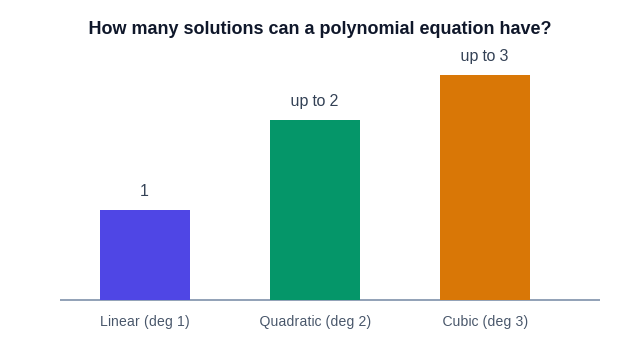
A degree-n polynomial equation has at most n solutions (counting complex ones, exactly n). The cubic x³ − 6x² + 11x − 6 = 0 factors by grouping or by testing x = 1 first: 1 − 6 + 11 − 6 = 0 ✓, so (x − 1) divides it, giving (x − 1)(x² − 5x + 6) = (x − 1)(x − 2)(x − 3), and x = 1, 2, 3. The bar chart above shows the pattern: the degree caps the solution count. The polynomial calculator handles roots and factoring for higher degrees.
4. Rational equations — denominators that bite
The unknown lives in a denominator: (x + 1)/3 = (x − 2)/2. Multiply both sides by the common denominator 6: 2(x + 1) = 3(x − 2), so 2x + 2 = 3x − 6 and x = 8. Check: 9/3 = 3 and 6/2 = 3 ✓. The trap: any candidate that makes an original denominator zero is forbidden, even if the algebra produces it — always state the excluded values first.
5. Radical equations — squaring creates impostors
The unknown sits under a root: √(x + 5) = x − 1. Square both sides: x + 5 = x² − 2x + 1, giving x² − 3x − 4 = 0, candidates x = 4 and x = −1. Squaring can manufacture answers, so check both in the original: x = 4 gives √9 = 3 = 4 − 1 ✓; x = −1 gives √4 = 2 but −1 − 1 = −2 ✗. x = 4 only — x = −1 is extraneous. Our radical equations guide drills this check.
6. Exponential equations — match the bases or take logs
The unknown is in the exponent: 2^(x+1) = 32. Since 32 = 2⁵, matching bases gives x + 1 = 5, x = 4. When the bases cannot match, take logarithms of both sides — the method in solving logarithm equations, with the exponent calculator for the arithmetic.
7. Logarithmic equations — the domain guards the door
log₂(x) + log₂(x − 2) = 3. Combine with the product rule: log₂(x(x − 2)) = 3, so x² − 2x = 8, x² − 2x − 8 = 0, candidates x = 4 and x = −2. But log₂(−2) does not exist, so x = 4 only. Check the domain before celebrating — the logarithm calculator evaluates the logs once you have a candidate.
8. Absolute value equations — two cases
|2x − 3| = 7 splits into 2x − 3 = 7 or 2x − 3 = −7, giving x = 5 or x = −2. Both check: |10 − 3| = 7 ✓ and |−4 − 3| = 7 ✓. One absolute value, two candidate lines — forget the negative case and you lose half the answer.
9. Systems of equations — one point that satisfies all
Two equations, two unknowns: x + y = 10 and x − y = 4. Add them: 2x = 14, x = 7, then y = 3. The solution (7, 3) satisfies both: 7 + 3 = 10 ✓ and 7 − 3 = 4 ✓. Substitution and elimination are the two standard engines — worked in full in how to solve systems of equations and automated by the system of equations solver.
Which solver for which type?
For a mixed problem, the equation solver routes most single-unknown types and shows its steps; the algebra calculator covers expressions and manipulation around them. A solid taxonomy reference is the OpenStax Algebra and Trigonometry chapter on equations — OpenStax, §2.2 Linear Equations in One Variable. Whatever the type, end the same way: substitute your solutions back into the original equation. It takes ten seconds and it is the difference between solving and guessing.