Algebra
Age Word Problems Solved Step by Step (With Examples)
Math Solver Free Team

Age word problems ask you to find how old people are now, were years ago, or will be years from now, from clues like “7 times as old” or “24 years older.” Almost every one hides a single linear equation. This guide teaches the table method first, then solves five real forum questions, including one that cannot be solved as stated — and shows why.
How to solve age word problems: the table method
Put the story in a table with three columns: now, years ago, and years hence (in the future). Each person gets a row, and each clue fills one cell or one relationship between cells:
- Choose x for the younger person's age now. The older age is usually described from it: “twice as old” becomes 2x, “24 years older” becomes x + 24.
- Write the other person's age now from the first clue. If nobody is described from the younger person, give them their own letter and use a system of equations solver approach.
- Fill the past and future columns. “2 years ago” means subtract 2 from every age; “in 10 years” or “10 years hence” means add 10 to every age. Time moves for everyone equally.
- Translate the second clue into one equation. “Times as old” means multiply the younger age at that moment; “years older” means add; “was” or “will be” is usually the equals sign.
- Solve the equation: expand brackets, collect x terms on one side. To see each step checked, use the equation solver.
- Check by substituting back into both clues, then sanity-check: ages must be positive and a parent plausibly older than a child.
Learn three translations cold. “A is 3 times as old as B” means A = 3 × B at that same moment. “A is 5 years older than B” means A = B + 5, and that gap stays the same forever. “Hence” means “from now” (+ years); “ago” always means subtract. Two separate facts about two unknowns may need two equations — see how to solve linear equations for the solving step in depth.
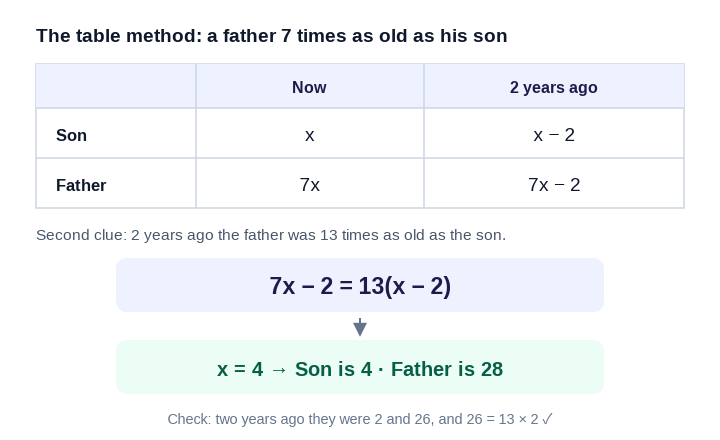
“A father is 7 times as old as his son. 2 years ago the father was 13 times as old as his son. How old are they now?”
Let x be the son's age now, so the father is 7x. Two years ago they were x − 2 and 7x − 2, and the father was then 13 times as old:
- Equation: 7x − 2 = 13(x − 2).
- Expand: 7x − 2 = 13x − 26.
- Collect terms: 26 − 2 = 13x − 7x, so 24 = 6x and x = 4.
- Answer: the son is 4 years old and the father is 7 × 4 = 28 years old.
Check: two years ago they were 2 and 26, and 26 = 13 × 2. ✓ Stuck? Compare your table with the word problem calculator.
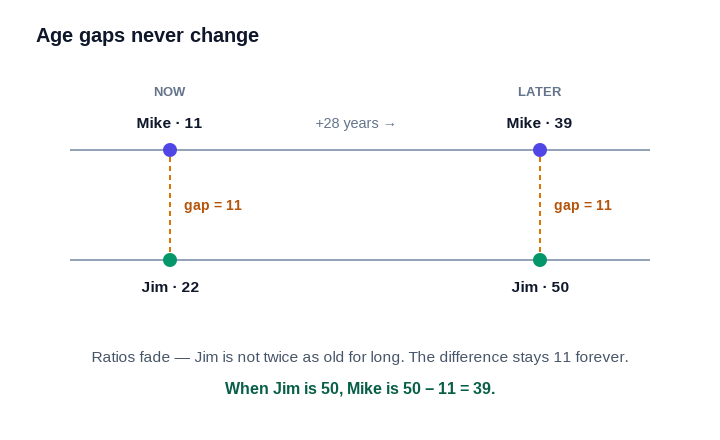
“Mike is 11 years old. Jim is twice as old as Mike. When Jim is 50 years old, how old will Mike be?”
This forum favourite needs no equation, because the difference between two ages never changes. Jim is 2 × 11 = 22 now, so the gap is 11 years, forever. When Jim is 50, Mike will be 50 − 11 = 39 years old.
Check: 28 years pass until Jim turns 50, and Mike also ages 28 years: 11 + 28 = 39. ✓ The trap is assuming “twice as old” lasts forever — ratios shrink, differences stay fixed. For “when A is N, how old is B?”, use the constant difference first.
“A father is twice as old as his son. Eighteen years ago, he was four times as old as his son. How old is the son now?”
Let x be the son now, so the father is 2x. Eighteen years ago they were x − 18 and 2x − 18, and the father was four times as old:
- Equation: 2x − 18 = 4(x − 18).
- Expand: 2x − 18 = 4x − 72.
- Collect terms: 72 − 18 = 4x − 2x, so 54 = 2x and x = 27.
- Answer: the son is 27 years old and the father is 2 × 27 = 54 years old.
Check: eighteen years ago they were 9 and 36, and 36 = 4 × 9. ✓ The son was alive 18 years ago, so x must exceed 18.
“A man is 24 years older than his son. How old is the son?” — when a problem is missing a fact
The honest answer is: it cannot be solved as stated. “24 years older” gives son = x and man = x + 24, but infinitely many pairs fit: 5 and 29, 18 and 42, 30 and 54. A single difference is only half an equation — you need a second condition: a sum, or a ratio now or at another time. A single number from this clue alone is a guess.
Here is the completed textbook version: in 6 years he will be twice as old as his son. Let x be the son now, so the man is x + 24; in 6 years they will be x + 6 and x + 30:
- Equation: x + 24 + 6 = 2(x + 6), that is, x + 30 = 2x + 12.
- Solve: 30 − 12 = 2x − x, so x = 18.
- Answer: the son is 18 years old and the man is 18 + 24 = 42 years old.
Check: in 6 years they will be 24 and 48, and 48 = 2 × 24. ✓ Count unknowns, then count independent facts: if facts are fewer, the problem — not you — is incomplete.
“Sara is 3 times as old as Ben. In 10 years she will be twice as old as Ben. How old are they?”
Let x be Ben now, so Sara is 3x. In 10 years they will be x + 10 and 3x + 10, and she will be twice as old:
- Equation: 3x + 10 = 2(x + 10).
- Expand and solve: 3x + 10 = 2x + 20, so x = 20 − 10 = 10.
- Answer: Ben is 10 years old and Sara is 3 × 10 = 30 years old.
Check: in 10 years they will be 20 and 40, and 40 = 2 × 20. ✓ A big multiplier now and a smaller one later is the most common shape in textbooks and exams. For a video-and-table treatment, see the ChiliMath age word problems lesson.
Common mistakes in age word problems
- Subtracting years from only one person. “5 years ago” applies to everyone; writing 7x − 5 for the father but x for the son breaks the timeline.
- Multiplying the age difference. A father who is 24 years older is still 24 years older in 6 years — never 2 × 24. Differences stay constant; only ratios change.
- Putting the multiplier on the wrong age. “Father is 3 times as old as the son” means father = 3 × son, not the reverse.
- Forgetting the brackets. “13 times as old as the son was” means 13(x − 2), not 13x − 2.
- Skipping the plausibility check. A “father aged 16”, a negative age, or a son older than his father signals a misread problem, not a finished answer.
Which tool should you use?
Use the word problem calculator, to turn words into an equation with steps. For a bare equation, the equation solver is faster; for two unknowns, use the system of equations solver. Different job, fair warning: the age calculator works from birth dates — it gives a real age on a real date, useful for forms and birthdays, but it cannot solve “times as old” clues.