Finance
Compound Interest Explained: Formula, Examples and the Rule of 72
Math Solver Free Team
Compound interest is interest earning interest: each period, the interest you have already earned is added to your balance, and the next period's interest is calculated on the bigger amount. That single twist turns steady, linear growth into a curve that bends upward — slowly at first, then dramatically. This guide explains the formula symbol by symbol, works a full 10-year example, compares compound with simple interest using real numbers, shows how compounding frequency changes the result, and finishes with the Rule of 72, the fastest mental shortcut in personal finance. You can test every number below in the compound interest calculator.
The compound interest formula, symbol by symbol
A = P(1 + r/n)^(nt)
- A — the final amount: your starting money plus all the interest, after t years.
- P — the principal: the amount you start with.
- r — the annual interest rate as a decimal. 5% becomes r = 0.05. This is the single most common place the calculation goes wrong (see Common mistakes).
- n — how many times interest is compounded per year: n = 1 for yearly, 4 for quarterly, 12 for monthly, 365 for daily.
- t — the time in years.
- nt (the exponent) — the total number of compounding periods. Monthly compounding for 10 years means 12 × 10 = 120 periods.
- r/n — the interest rate per period. Monthly at 5% a year means each month adds 0.05 ÷ 12 ≈ 0.004167, about 0.4167%.
The interest earned is simply A − P: what you end with, minus what you started with.
Full worked example: $1,000 at 5% for 10 years
Invest P = $1,000 at r = 5% = 0.05, compounded yearly (n = 1), for t = 10 years.
- Write the formula with the values: A = 1000 × (1 + 0.05/1)^(1 × 10) = 1000 × (1.05)^10.
- Evaluate the power: 1.05^10 = 1.6288946… Each year multiplies the balance by 1.05, and ten years means ten such multiplications.
- Multiply by the principal: A = 1000 × 1.6288946 = $1,628.89.
- Interest earned: 1,628.89 − 1,000 = $628.89.
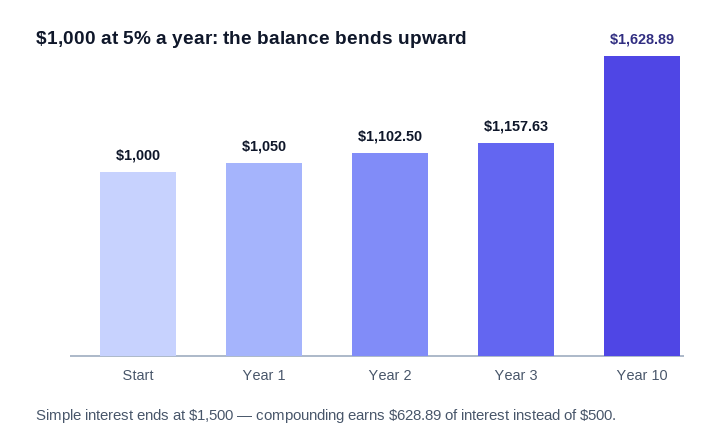
Watch the balance grow year by year to see compounding at work: after year 1 it is 1000 × 1.05 = $1,050.00; after year 2, 1050 × 1.05 = $1,102.50; after year 3, 1102.50 × 1.05 = $1,157.63. The interest grows each year — $50.00, then $52.50, then $55.13 — because each year's 5% is taken of a larger balance. By year 10 the balance earns about $77.57 in a single year, more than one and a half times the first year's interest, with no extra deposits.
Compound vs simple interest, with numbers
Simple interest is always calculated on the original principal only: Interest = P × r × t. The same $1,000 at 5% for 10 years earns 1000 × 0.05 × 10 = $500, ending at $1,500.00. Compound interest ended at $1,628.89 — an extra $128.89 that came purely from interest earning interest.
The gap widens brutally with time. At 20 years, simple interest still just doubles the interest to $1,000, ending at $2,000. Compound interest gives 1000 × 1.05^20 = 1000 × 2.6533 = $2,653.30. At 30 years the figures are $2,500 simple versus about $4,321.94 compound. Time in the market matters more than the rate for exactly this reason: the curve's steep part is always at the end.
How compounding frequency changes the result
Hold everything fixed — $1,000, 5%, 10 years — and change only n:
- Yearly (n = 1): 1000 × (1.05)^10 = $1,628.89
- Half-yearly (n = 2): 1000 × (1.025)^20 = $1,638.62
- Quarterly (n = 4): 1000 × (1.0125)^40 = $1,643.62
- Monthly (n = 12): 1000 × (1 + 0.05/12)^120 = $1,647.01
- Daily (n = 365): 1000 × (1 + 0.05/365)^3650 = $1,648.66
More frequent compounding always pays a little more — your interest starts earning its own interest sooner — but the gains shrink fast: monthly beats yearly by $18.12 over the decade, while daily beats monthly by only $1.65. When comparing accounts, a slightly higher rate almost always beats a slightly faster compounding schedule.
The Rule of 72: how long until money doubles?
Divide 72 by the annual rate (as a percentage) to estimate the years needed for an investment to double:
- At 6%: 72 ÷ 6 = 12 years. Check: 1.06^12 = 2.0122 — just over double. ✓
- At 8%: 72 ÷ 8 = 9 years. Check: 1.08^9 = 1.9990 — just under double. ✓
- At 9%: 72 ÷ 9 = 8 years to double; at 4%, 72 ÷ 4 = 18 years.
The rule also works in reverse: money left in an account earning 2% while prices rise 6% a year loses half its buying power in roughly 72 ÷ 6 = 12 years. The Rule of 72 is an estimate — most accurate between about 5% and 12% — but it is accurate enough for every quick decision, and the compound interest calculator gives the exact figure when you need it.
A second worked example: starting bigger, earning more
Invest $2,000 at 7% compounded yearly for 10 years: A = 2000 × (1.07)^10. Since 1.07^10 = 1.967151…, A = 2000 × 1.967151 = $3,934.30, of which $1,934.30 is interest — very nearly a second principal earned without adding a cent. Doubling the starting amount doubled the interest, and raising the rate from 5% to 7% raised the growth factor from 1.629 to 1.967. Principal, rate, and time are the three levers; time is the one you cannot buy back.
Common mistakes
- Using 5 instead of 0.05 for r. The formula needs the decimal form. (1 + 5)^10 is not a savings plan, it is an error of about nine orders of magnitude.
- Forgetting n in the exponent. Monthly compounding for 10 years is 120 periods, so the exponent is nt = 120, not 10 — and the rate inside must be r/n to match.
- Expecting linear growth. Compound growth looks disappointingly flat for the first years and explosive later. Judging a 30-year plan by its year-3 balance misleads completely.
- Comparing rates with different compounding. A 5% rate compounded daily beats 5% compounded yearly (see the table above). Compare final amounts, not headline rates.
- Ignoring inflation and tax. A is the nominal amount. Real growth is what remains after prices rise; the Rule of 72 applies to inflation just as it does to returns.
How the compound interest calculator helps
The compound interest calculator evaluates A = P(1 + r/n)^(nt) instantly for any principal, rate, term, and compounding frequency, and separates the interest from the principal so you can see exactly what compounding contributed. Use it to compare two savings accounts honestly (final amount, not headline rate), to find the rate or the years needed to reach a target, and to check Rule-of-72 estimates before you rely on them.
Frequently asked questions
What is the compound interest formula?
A = P(1 + r/n)^(nt), where P is the principal, r the annual rate as a decimal, n the number of compounding periods per year, t the years, and A the final amount. The interest earned is A − P.
How much does $1,000 grow at 5% for 10 years?
Compounded yearly, 1000 × 1.05^10 = $1,628.89, so the interest is $628.89. Compounded monthly it reaches $1,647.01.
What is the difference between simple and compound interest?
Simple interest is paid only on the original principal: $1,000 at 5% for 10 years earns a flat $500. Compound interest is also paid on past interest, earning $628.89 in the same scenario — and the gap grows with time.
What is the Rule of 72?
Divide 72 by the annual percentage rate to estimate the years for money to double: at 8%, about 9 years; at 6%, about 12 years. It is an approximation, most accurate for rates between roughly 5% and 12%.
Does compounding more often make a big difference?
A small one. Over 10 years at 5% on $1,000, monthly compounding ($1,647.01) beats yearly ($1,628.89) by $18.12, and daily adds only $1.65 more. Rate and time matter far more than frequency.
Why does compound interest grow faster over time?
Because the base keeps growing: each period's interest is calculated on the principal plus all previous interest, so the interest itself gets larger every period even though the rate never changes.