Math Guides
How to Solve Systems of Equations: 3 Methods Explained
Math Solver Free Team

A system of equations is two or more equations that must be true at the same time. Solving it means finding the values that satisfy every equation in the system. For two lines, that answer is usually one point: the place where the lines cross. This guide teaches you how to solve systems of equations by graphing, substitution, and elimination, with a fully worked example for each method, so you can pick the fastest method on any problem.
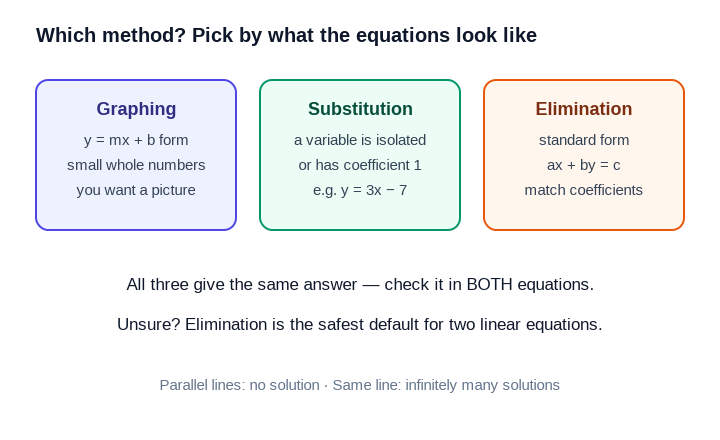
Try the short version first. If one equation already gives you y (or x) on its own, use substitution. If the coefficients already match or are opposites, use elimination. If you need a picture of what is happening, or the numbers are small and friendly, use graphing. All three methods give the same answer when they are done correctly, so the best method is the one that fits the equations in front of you.
What does the solution of a system mean?
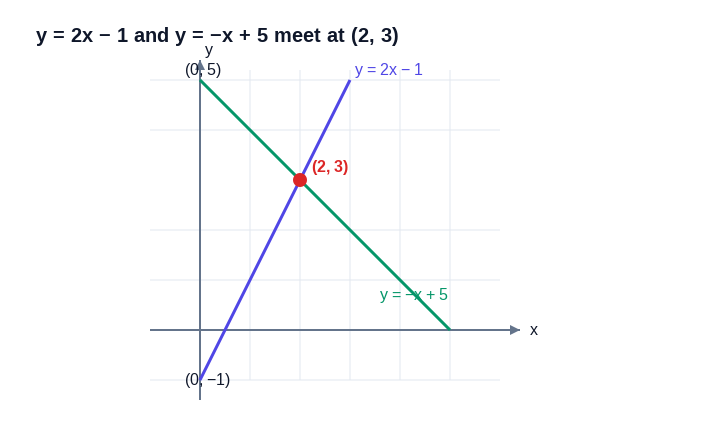
Take the system y = 2x − 1 and y = −x + 5. A solution is an ordered pair (x, y) that makes both equations true. The pair (2, 3) works: 2(2) − 1 = 3, and −2 + 5 = 3. The pair (0, 5) fails the first equation, because 2(0) − 1 = −1, not 5. That is the whole test, and it is also your safety net: whatever method you use, plug your answer back into both original equations before you finish.
Geometrically, each linear equation is a straight line, and the solution is the intersection point of the lines. That picture also explains the two special cases. Parallel lines never meet, so the system has no solution. Two equations that describe the same line meet everywhere, so the system has infinitely many solutions. You will meet both cases below.
Which method should you use?
Choosing well saves more time than any shortcut. Use this picker before you start writing:
- Graphing: the equations are already in y = mx + b form, the numbers are small, and you want to see the answer. Weakness: it is hard to read fractional answers exactly from a hand-drawn graph.
- Substitution: one equation is already solved for a variable, or a variable has coefficient 1 or −1 so isolating it is one step. This is the natural choice for systems like y = 3x − 7 with 2x + y = 8.
- Elimination: both equations are in standard form (ax + by = c), no variable is isolated, and coefficients can be made to match with a small multiplier. This is usually the fastest method for textbook-style systems.
If you are unsure, elimination is the safest default for two linear equations: it works even when nothing is isolated, and it keeps fractions away longer than substitution often does.
Method 1: solve by graphing
Graphing turns algebra into a picture. Plot both lines on the same axes and read off the crossing point.
- Put each equation in slope-intercept form, y = mx + b, if it is not already there.
- Plot each line using its y-intercept and slope, or a small table of values.
- Read the intersection point. If the lines cross exactly on a grid point, that point is your candidate answer.
- Check the point in both original equations. A graph can mislead you by a square; the check cannot.
Worked example. Solve y = 2x − 1 and y = −x + 5 by graphing. The first line crosses the y-axis at (0, −1) and rises 2 for every 1 across, giving points (0, −1), (1, 1), (2, 3). The second line crosses at (0, 5) and falls 1 for every 1 across, giving points (0, 5), (1, 4), (2, 3). Both lines pass through (2, 3), so the solution is x = 2, y = 3. Check: 2(2) − 1 = 3 and −2 + 5 = 3. Both equations hold, so the answer is confirmed.
Graphing is also the best way to understand the special cases: parallel lines stay apart forever, and identical lines lie exactly on top of each other. When a test asks you to solve by graphing, it usually chooses friendly whole-number answers on purpose.
Method 2: solve by substitution
Substitution uses one equation to replace a variable in the other, turning two equations in two unknowns into one equation in one unknown.
- Isolate one variable in one equation, if it is not isolated already. Pick the variable with coefficient 1 or −1 when you can.
- Substitute that expression into the other equation. Put brackets around it.
- Solve the one-variable equation.
- Substitute the value back into the isolated expression to find the other variable.
- Check both values in both original equations.
Worked example. Solve y = 3x − 7 and 2x + y = 8. The first equation already isolates y, so substitute 3x − 7 for y in the second equation: 2x + (3x − 7) = 8. Combine: 5x − 7 = 8, so 5x = 15 and x = 3. Back-substitute: y = 3(3) − 7 = 2. The solution is (3, 2). Check in the second equation: 2(3) + 2 = 8. Correct.
The classic substitution mistake is dropping the brackets: 2x + 3x − 7 is not the same as 2x + (3x − 7) when a minus sign or a multiplier is involved. For example, substituting y = 2x + 1 into 3x − 2y = 5 gives 3x − 2(2x + 1) = 5, which is 3x − 4x − 2 = 5, not 3x − 4x + 2 = 5. Always write the brackets.
Method 3: solve by elimination
Elimination adds or subtracts the equations so that one variable disappears. It shines when both equations are in standard form.
- Line the equations up with x-terms, y-terms, and constants in columns.
- Multiply one or both equations by a constant so that one variable has equal or opposite coefficients.
- Add or subtract the equations to eliminate that variable, then solve for the other.
- Substitute back into either original equation to find the eliminated variable.
- Check in both original equations.
Worked example (coefficients already opposite). Solve 3x + 2y = 12 and 5x − 2y = 4. The y-coefficients are +2 and −2, so add the equations: 8x = 16, giving x = 2. Substitute into the first equation: 3(2) + 2y = 12, so 2y = 6 and y = 3. The solution is (2, 3). Check in the second equation: 5(2) − 2(3) = 4. Correct.
Worked example (multiplier needed). Solve 2x + 3y = 12 and 3x − y = 7. Multiply the second equation by 3 to match the y-coefficients: 9x − 3y = 21. Add to the first equation: 11x = 33, so x = 3. Substitute into 3x − y = 7: 9 − y = 7, so y = 2. The solution is (3, 2). Check: 2(3) + 3(2) = 12 and 3(3) − 2 = 7. Both hold.
When you multiply an equation, multiply every term, including the constant on the right. Forgetting the constant is the most common elimination error, and the check step is what catches it.
Special cases: no solution and infinitely many solutions
Sometimes the algebra refuses to give one point, and that is the answer, not a mistake. If the variables cancel and leave a false statement, such as 0 = 5, the lines are parallel and the system has no solution. Example: y = 2x + 1 and y = 2x − 4 have the same slope but different intercepts, so they never meet.
If the variables cancel and leave a true statement, such as 0 = 0, the equations describe the same line and the system has infinitely many solutions. Example: 2x + y = 6 and 4x + 2y = 12 are the same line, since the second equation is just the first doubled. Every point on the line is a solution. On a test, write "infinitely many solutions" rather than guessing one point.
Word problems: turn the story into a system
Most word problems hide two relationships. Name the unknowns, translate each sentence into an equation, then solve by the method that fits.
Worked example. A cinema sells 20 tickets for $195. Adult tickets cost $12 and child tickets cost $7. How many of each were sold? Let a be adult tickets and c be child tickets. The count gives a + c = 20, and the money gives 12a + 7c = 195. Substitute c = 20 − a into the money equation: 12a + 7(20 − a) = 195, so 12a + 140 − 7a = 195, giving 5a = 55 and a = 11. Then c = 20 − 11 = 9. Check: 11 + 9 = 20 tickets and 12(11) + 7(9) = 132 + 63 = 195 dollars. The answer makes sense in the story, which is the final check word problems need.
Common mistakes to avoid
- Skipping the check. One substitution into both equations catches sign slips, bracket slips, and arithmetic slips in seconds.
- Substituting into the same equation. After isolating y in equation 1, substitute into equation 2, not back into equation 1.
- Multiplying only part of an equation. In elimination, the multiplier applies to every term, including the constant.
- Reading a graph answer as exact when it is not. If the lines cross between grid points, confirm with algebra.
- Stopping at one variable. A system asks for both values; an answer like x = 3 alone is incomplete.
- Mixing up no solution and infinitely many. A false statement (0 = 5) means none; a true statement (0 = 0) means all points on the line.
Practice: try these, then check
Solve each system, then verify in both equations: (1) y = x + 4 and y = −2x + 1; (2) 4x + y = 9 and 2x − y = 3; (3) x + 3y = 11 and 2x − y = 2. Answers: (1) (−1, 3); (2) (2, 1); (3) (2, 3). If any answer fails its check, redo only the step where the check first breaks: that is where the error lives. For instant checking, try our free system of equations solver, then review the method in our linear equations guide or the slope guide. For a second explanation of the three methods, see FreeMathHelp on solving systems algebraically.