Calculus
Improper Integrals: Convergence, Divergence & Worked Examples
Math Solver Free Team

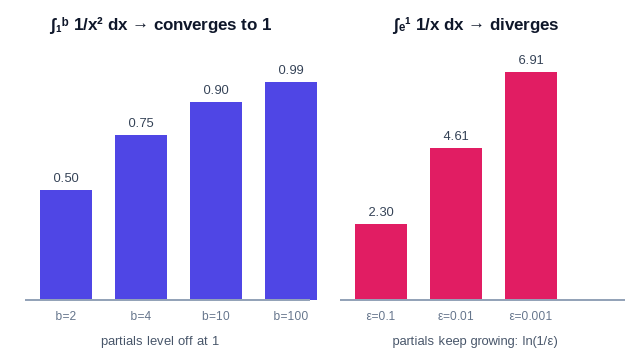
An improper integral is a definite integral that reaches too far (an infinite limit of integration) or touches a point where the function blows up (a vertical asymptote inside the interval). You cannot evaluate one by substitution — infinity is not a number — so every improper integral is secretly a limit: replace the offending endpoint with a variable, integrate normally, then let the variable approach its target. If that limit is a finite number, the integral converges and the number is its value. If the limit is infinite or does not exist, the integral diverges — even when the region looks like it should have a modest area. This guide works both kinds in full, checks every claimed value numerically, and finishes with the p-test that classifies the most common improper integrals on sight.
The two types of improper integral
Type 1 has an infinite endpoint: ∫₁^∞ 1/x² dx or ∫₀^∞ e^(−x) dx. Type 2 has a blow-up: ∫₀¹ 1/x dx explodes at x = 0, and ∫₀³ 1/(x − 1) dx explodes in the middle, at x = 1. Both types are handled the same way — turn the problem point into a limit. If the blow-up sits inside the interval, split the integral there and evaluate each side separately; the whole thing converges only if both sides do.
Worked example 1 (Type 1, converges): ∫₀^∞ e^(−x) dx
Replace ∞ with b: ∫₀ᵇ e^(−x) dx = [−e^(−x)]₀ᵇ = 1 − e^(−b). Now let b → ∞: e^(−b) → 0, so the integral converges to 1. The area under the exponential curve, out to infinity, is exactly 1 — a finite area under an infinitely long tail, because the curve falls fast enough. Numeric check (Simpson's rule out to x = 60, where e^(−60) is below 10^(−26)): 0.999999999998, matching 1 − 0 = 1.
Worked example 2 (Type 1, converges conditionally on p): ∫₁^∞ 1/x² dx
With endpoint b: ∫₁ᵇ x^(−2) dx = [−1/x]₁ᵇ = 1 − 1/b → 1 as b → ∞. Simpson's rule out to 2000 gives 0.9995, exactly 1 − 1/2000 as the formula predicts. But change the exponent and the answer flips: ∫₁^∞ 1/x dx = ln b → ∞, divergent. The dividing line is the p-test: ∫₁^∞ 1/xᵖ dx converges if and only if p > 1 (its value is then 1/(p − 1)). At p = 1 it diverges, painfully slowly — the partial values grow like the natural log.
Worked example 3 (Type 2, diverges): ∫₀¹ 1/x dx
The blow-up is at the left endpoint. Replace 0 with ε and integrate: ∫_ε¹ 1/x dx = ln 1 − ln ε = ln(1/ε). As ε → 0⁺, ln(1/ε) → ∞, so the integral diverges. Numerically: cutting off at ε = 10⁻⁶ already gives ≈ 14.35 (Simpson) versus the exact partial value ln(10⁶) ≈ 13.82 — the area keeps accumulating without bound as the cutoff shrinks. The symmetric p-test at 0: ∫₀¹ 1/xᵖ dx converges if and only if p < 1 (value 1/(1 − p)); so ∫₀¹ 1/√x dx = 2 converges while ∫₀¹ 1/x dx does not.
The comparison test: classify without integrating
When an antiderivative is out of reach, compare. If 0 ≤ f(x) ≤ g(x) on the interval and ∫g converges, then ∫f converges; if ∫f diverges, then ∫g diverges. Two everyday uses: ∫₁^∞ (1 + sin²x)/x² dx converges because its integrand is trapped between 1/x² and 2/x², both p = 2 convergent. And ∫₁^∞ dx/(x + eˣ) converges brutally fast — for x ≥ 1 the denominator exceeds eˣ, so the integrand is below e^(−x), whose integral we already know equals 1. For numerical experiments with ordinary definite integrals, use our definite integral calculator; for antiderivatives themselves, the integral calculator. The analytic reference for the convergence tests is OpenStax Calculus Volume 2, §3.7 (Improper Integrals).
The trap: symmetric cancellation
∫₋∞^∞ x dx looks like it should be 0 by symmetry — the negative side cancels the positive side. It is actually divergent: the definition requires both halves, ∫₋∞⁰ x dx and ∫₀^∞ x dx, to converge separately, and each is infinite. Never cancel infinities against each other; split first, and only combine limits that both exist. (The symmetric limit has a name — the Cauchy principal value — but it is a different, weaker notion than convergence.)
The p-test: one rule that settles whole families
Two families recur so often that their verdicts are worth memorising as a single rule. At infinity, ∫₁^∞ 1/x^p dx converges exactly when p > 1: the tail of 1/x² dies fast enough to accumulate only 1, while 1/x (p = 1) and 1/√x (p = 1/2) decay too slowly and diverge. At a singularity the inequality flips: ∫₀¹ 1/x^p dx converges exactly when p < 1, because a blow-up that is steep but narrow can still enclose finite area. The two halves are mirror images — at infinity you need the function to fall fast, at a spike you need it to rise slowly — and between them they classify most improper integrals on sight, before any antiderivative is attempted. The comparison test then extends the verdict to neighbours: anything squeezed below a convergent p-integral converges, and anything above a divergent one diverges.
Worked example 4 (Type 2, converges): ∫₀¹ 1/√x dx
The integrand 1/√x blows up at x = 0, so the integral is improper even though the interval is short. Replace the bad endpoint with t and take the limit: ∫ₜ¹ x^(−1/2) dx = [2√x]ₜ¹ = 2 − 2√t, and as t → 0⁺ the second term vanishes, leaving exactly 2. The region under the curve is infinitely tall at one edge yet encloses a finite area of 2 — the picture worth keeping, because it is the whole point of Type 2 integrals: unbounded is not the same as infinite. The p-test agrees instantly, since p = 1/2 < 1 on the singularity side.