Calculus
Double Integrals: Volume Under a Surface, Worked Examples
Math Solver Free Team

A double integral ∬_R f(x, y) dA does for two variables what an ordinary integral does for one: it accumulates a quantity over a region. When f ≥ 0 it is the volume under the surface z = f(x, y) above the region R; when f = 1 it is just the area of R. You evaluate it as an iterated integral — two ordinary integrals nested inside each other — and that mechanical fact hides two genuine skills: setting the limits from the region's shape, and knowing when swapping the order of integration turns a hard problem into an easy one. Both worked examples below are verified by independent numerical integration.
Worked example 1 (rectangle): ∬ xy dA over [0, 1] × [0, 2]
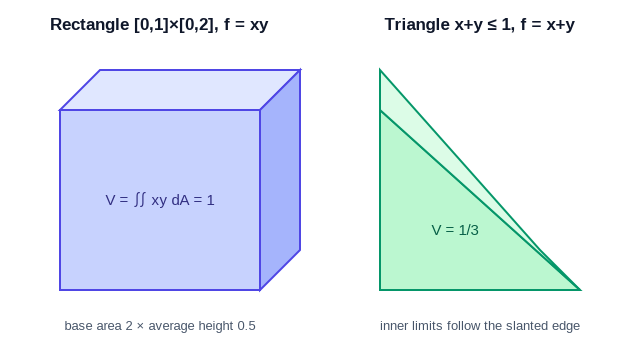
On a rectangle the limits are constants. Integrate inside-out, treating the other variable as constant — exactly the partial-derivative move in reverse. Inner integral over y: ∫₀² xy dy = x · [y²/2]₀² = 2x. Outer integral over x: ∫₀¹ 2x dx = [x²]₀¹ = 1. So the volume under z = xy over the 1-by-2 rectangle is exactly 1 — believable, since the surface averages about 0.5 over a base of area 2. A 400 × 400 midpoint-grid evaluation gives 1.0000000000000064, confirming the value numerically.
Worked example 2 (triangle): ∬ (x + y) dA where x ≥ 0, y ≥ 0, x + y ≤ 1
Non-rectangular regions make the inner limits functions. Slice vertically: for a fixed x, y runs from 0 up to the slanted edge y = 1 − x, and x itself runs 0 to 1. Inner: ∫₀^(1−x) (x + y) dy = x(1 − x) + (1 − x)²/2. Outer: ∫₀¹ [x − x² + (1 − 2x + x²)/2] dx = ∫₀¹ (1/2 − x²/2) dx = [x/2 − x³/6]₀¹ = 1/2 − 1/6 = 1/3. A midpoint-grid evaluation over the triangle gives 0.33333359, confirming 1/3. Slice the other way — horizontal strips with x from 0 to 1 − y — and the same 1/3 falls out: Fubini's theorem guarantees both orders agree on continuous functions.
Setting up limits: the three questions
That f = 1 check catches most setup errors before any real integration starts. For the single-variable machinery inside each layer, the integral calculator and definite integral calculator handle the antiderivatives and evaluations; the theory reference is OpenStax Calculus Volume 3, §5.2 (Double Integrals over General Regions).
When to swap the order of integration
Swap when the inner integral is impossible or ugly in the given order. The classic case: ∬ e^(y²) dA over the triangle 0 ≤ x ≤ y ≤ 1. Integrating x first gives ∫₀¹ e^(y²) · y dy, which falls to the substitution u = y² and equals (e − 1)/2. Integrating y first demands ∫ e^(y²) dy — no elementary antiderivative exists. Rule of thumb: if the integrand contains a function of one variable alone that has no elementary antiderivative, make that variable the outer one.
What double integrals are for
Volume is the headline, but the same machinery computes mass from a density, the average value of a function over a region, probabilities for two continuous random variables, and centres of mass. In every application the setup skill is the same: describe the region precisely, choose a strip direction, and let the two nested integrals do the accumulation.
Worked example 3 (polar coordinates): the area of a disk
Some regions fight the x–y description and surrender to polar coordinates. The disk of radius 2 is the standard case: in Cartesian form its boundary forces square roots into the limits, but in polar form the region is simply 0 ≤ θ ≤ 2π and 0 ≤ r ≤ 2. The area is ∬ dA over the disk, which becomes ∫₀^{2π} ∫₀² r dr dθ — note the factor r, which is not decoration but the Jacobian, the local area scaling of polar coordinates. The inner integral gives [r²/2]₀² = 2, and the outer integral gives 2π × 2 = 4π — exactly πr² with r = 2, as it must be. When a region is a disk, an annulus or a sector, or the integrand contains x² + y², polar coordinates are usually the intended path; the same r factor appears every time.
Common setup mistakes
- Forgetting the Jacobian. In polar coordinates dA becomes r dr dθ, never dr dθ. Dropping the r silently computes a different, smaller quantity.
- Constant limits on a non-rectangle. If the region is a triangle or a disk, at least one limit must be a function of the other variable. A double integral with four constant limits is always a rectangle, whether you meant it to be or not.
- Swapping the order without redrawing. Reversing the integration order means re-describing the same region with strips in the other direction — the limits almost always change. Sketch the region first; the picture is the setup.
- Reading the answer as the function value. A double integral accumulates over an area, so its units are the integrand units times area units — a volume, a mass, a probability — never the height at a point.