Geometry
Vector Components and Unit Vectors, Explained with Examples
Math Solver Free Team

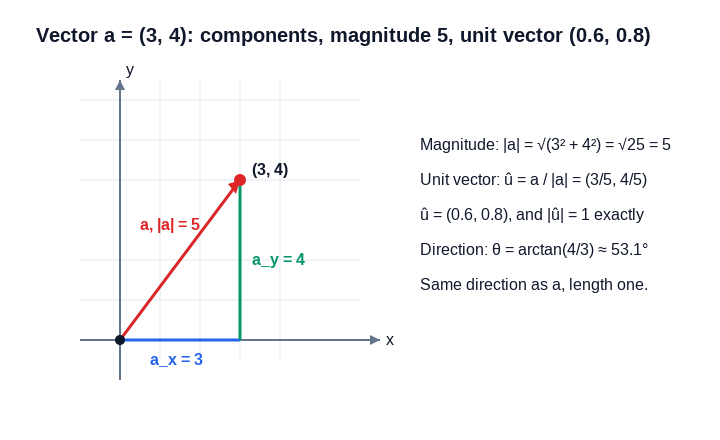
A vector is a quantity with both size and direction — a push, a velocity, a displacement. Vector components are how you make a vector usable: split it into a horizontal part and a vertical part, and suddenly you can add vectors, compare them and compute with them. A unit vector is the final polish: the same direction, rescaled to length exactly 1. This guide covers vector components and unit vectors together, because in practice you almost always need both — components first, then the unit vector built from them.
What are vector components?
Any 2D vector a can be written as a = (a_x, a_y). The number a_x is the x-component: how far the vector reaches horizontally. The number a_y is the y-component: how far it reaches vertically. Together the components are the vector — walk a_x steps east and a_y steps north and you end up exactly where the vector points. Components are signed: a vector pointing left has a negative a_x, and one pointing down has a negative a_y.
How do you find the magnitude and direction of a vector?
The components form a right triangle with the vector as hypotenuse, so Pythagoras does the work. For a = (a_x, a_y):
- Magnitude: |a| = √(a_x² + a_y²) — always zero or positive.
- Direction: θ = arctan(a_y / a_x), measured from the positive x-axis. Watch the quadrant: if a_x is negative, the angle is in the second or third quadrant, so add 180° to the raw arctan result.
- Backwards: from magnitude and angle, a_x = |a| cos θ and a_y = |a| sin θ.
Worked example 1: components, magnitude and unit vector of a = (3, 4)
This vector is the classic 3-4-5 triangle. Its magnitude is |a| = √(3² + 4²) = √25 = 5. Its direction is θ = arctan(4/3) ≈ 53.1° above the x-axis. The unit vector in the same direction is û = a / |a| = (3/5, 4/5) = (0.6, 0.8). Check: |(0.6, 0.8)| = √(0.36 + 0.64) = √1 = 1, exactly as a unit vector must be.
What is a unit vector, and how do you find one?
A unit vector is any vector of length 1. To turn a vector a into the unit vector pointing the same way, divide every component by the magnitude: û = a / |a|. Dividing by a positive number shrinks the length without turning the direction at all. Two unit vectors are so common they have their own names: i = (1, 0) points along the x-axis and j = (0, 1) along the y-axis, which is why any vector can also be written a = a_xi + a_yj — for our example, 3i + 4j.
How do you add vectors and scale them with components?
Components turn vector arithmetic into ordinary arithmetic, one coordinate at a time:
- Addition: (a_x, a_y) + (b_x, b_y) = (a_x + b_x, a_y + b_y).
- Subtraction: subtract component by component the same way.
- Scaling: k(a_x, a_y) = (k·a_x, k·a_y). A negative k also flips the direction.
Worked example 2: adding a = (3, 4) and b = (6, −2)
Add component by component: a + b = (3 + 6, 4 + (−2)) = (9, 2). The sum's magnitude is |(9, 2)| = √(81 + 4) = √85 ≈ 9.22 — notice it is not 5 + |b|: magnitudes do not add unless the vectors point the same way. Doubling b instead gives 2b = (12, −4) with magnitude √160 ≈ 12.65, exactly twice |b| = √40 ≈ 6.32, because scaling by a positive number stretches the length by the same factor.
Where the dot product meets components
Components are also the working form of the dot product: u · v = u_x·v_x + u_y·v_y. Take u = (5, 12) and v = (8, 6): the dot product is 5×8 + 12×6 = 40 + 72 = 112. Since |u| = 13 and |v| = 10, the angle between them satisfies cos θ = 112 / (13 × 10) ≈ 0.862, so θ ≈ 30.5°. A dot product of zero is the instant test for perpendicular vectors. Compute any of these yourself with our dot product calculator, and keep the general-purpose free math solver open for the arithmetic around them.
Common mistakes with vector components and unit vectors
- Swapping the components. (4, 3) is a different vector from (3, 4) — same magnitude, different direction (36.9° instead of 53.1°). Order is the whole point.
- Forgetting the quadrant. arctan(4 / −3) on a calculator returns about −53.1°, but the vector (−3, 4) points up-left, at 126.9°. Adjust by 180° whenever a_x is negative.
- Dividing only one component. A unit vector needs every component divided by the magnitude. (3, 4) → (0.6, 4) is not a unit vector; its length is about 4.04.
- Adding magnitudes instead of components. |a + b| equals |a| + |b| only when both vectors point in exactly the same direction.
For the standard reference treatment of vectors and their components, see the OpenStax University Physics chapter on vectors — free and written for first-year university courses.
Frequently asked questions
What is the difference between a vector and its components?
The vector is the whole arrow — size and direction together. Its components are the pair of numbers (a_x, a_y) describing how far that arrow reaches horizontally and vertically. The components are a description of the vector, the coordinate form you actually compute with.
How do you find a unit vector?
Divide the vector by its own magnitude: û = a / |a|. For a = (3, 4), |a| = 5, so û = (0.6, 0.8). The result always has length exactly 1 and points in the same direction as the original.
Can a component be negative or bigger than the magnitude?
Negative, yes — a component is negative whenever the vector points in the negative axis direction. Bigger than the magnitude, never: each component is one leg of a right triangle whose hypotenuse is the magnitude, so |a_x| ≤ |a| and |a_y| ≤ |a| always.
What are i and j in vectors?
i = (1, 0) and j = (0, 1) are the standard unit vectors along the x and y axes. Writing a = 3i + 4j is exactly the same information as a = (3, 4): three units of i plus four units of j.
How are vector components used in physics?
Forces, velocities and accelerations are split into components so each direction can be analysed separately: a projectile's horizontal motion is constant while its vertical motion accelerates under gravity. Navigation, engineering statics and computer graphics all run on the same split-into-components idea.