Math Guides
LCM and HCF Word Problems: How to Tell Which One to Use
Math Solver Free Team

LCM and HCF word problems rarely fail students on arithmetic. They fail on one decision: does this story want the lowest common multiple (LCM) or the highest common factor (HCF)? Pick wrong and every later step is wrong. This guide fixes that decision: signal words, the prime-factor method, the shortcut a × b = HCF × LCM, and four forum questions solved in full.
LCM and HCF word problems start with two definitions
A factor of a number divides it exactly, with no remainder. The HCF of two or more numbers is the largest factor they all share. A multiple of a number is a value in its times table. The LCM is the smallest multiple they all share. Example: the factors of 12 are 1, 2, 3, 4, 6 and 12 and the factors of 18 are 1, 2, 3, 6, 9 and 18, so their HCF is 6. Multiples of 12 run 12, 24, 36, 48 and multiples of 18 run 18, 36, 54, so their LCM is 36.
Sanity checks: the HCF never exceeds the smallest given number, and the LCM is never below the largest; breaking either rule means you swapped them. HCF is the UK, Pakistani and Indian term; US readers know the same value as the GCD (greatest common divisor) or GCF (greatest common factor). See Math Is Fun on the greatest common factor and our LCM and HCF calculator.
How to tell which one a word problem wants
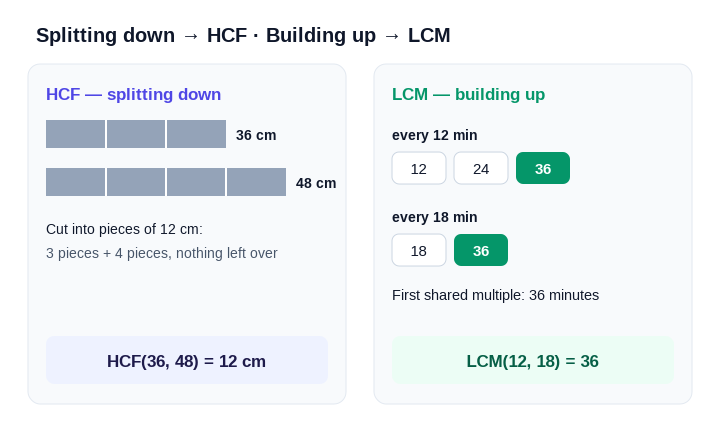
Ask first: is the story splitting things down, or building things up? Splitting into equal parts, nothing left over, parts as large as possible, is always HCF. Building up until cycles meet or totals match is always LCM.
Choose HCF when the story contains signals like these:
- Cutting ribbons, ropes or tiles into the longest equal pieces with no waste.
- Sharing or packing amounts into identical groups, boxes or rows, using everything up.
- The largest square tile covering a floor exactly, or the greatest measure for two lengths.
- Signal words: greatest, largest, longest, maximum, split, divide equally, no remainder, no leftovers.
Choose LCM when the story contains signals like these:
- Buses, bells or lights on different cycles that must happen together again.
- The smallest total that two different pack sizes can both make exactly.
- Events coinciding: next meeting, first time together.
- Signal words: smallest, least, minimum, together again, next time, every … minutes, repeat.
The prime-factor method: 36 and 48 worked in full
Prime factors give both values from the same working and scale to numbers too big for listing. Test small primes with our prime number checker and split stubborn numbers with the factoring calculator.
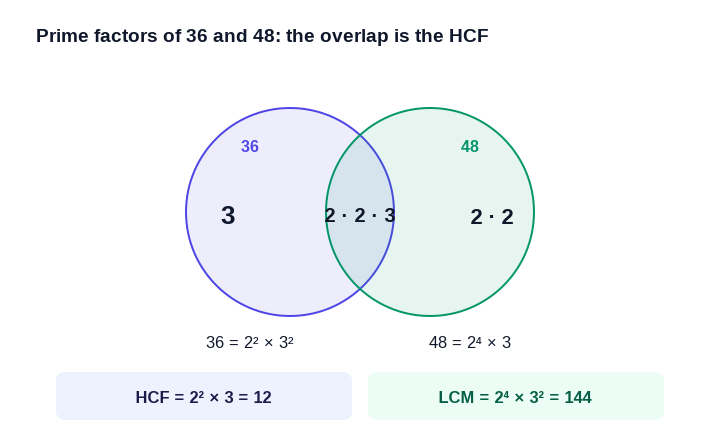
- Factorise both numbers: 36 = 2 × 2 × 3 × 3 = 2^2 × 3^2, and 48 = 2 × 2 × 2 × 2 × 3 = 2^4 × 3.
- For the HCF, take each common prime at its smaller power: 2^2 (not 2^4) and 3^1 (not 3^2). HCF = 2^2 × 3 = 4 × 3 = 12.
- For the LCM, take every prime at its larger power: 2^4 and 3^2. LCM = 2^4 × 3^2 = 16 × 9 = 144.
- Check: 36 × 48 = 1,728 and 12 × 144 = 1,728 — the products match.
Word problem 1: two ribbons cut into the longest equal pieces
Question: Two ribbons, 36 cm and 48 cm long, are cut into pieces of one length, as long as possible, with nothing left over. How long is each piece?
Cutting into equal pieces with no waste is the classic HCF signal, so HCF(36, 48) = 12: each piece is 12 cm long. The short ribbon gives 36 ÷ 12 = 3 pieces and the long one 48 ÷ 12 = 4 pieces — 7 pieces, no waste. A 24 cm piece would strand an unusable offcut on the 36 cm ribbon — exactly what the HCF prevents.
Word problem 2: two buses that leave together
Question: One bus leaves a station every 12 minutes and another every 18 minutes. Both leave together at 9:00. When do they next leave together?
Cycles lining up again is the classic LCM signal. Multiples of 12: 12, 24, 36, 48. Multiples of 18: 18, 36, 54. The first shared multiple is LCM(12, 18) = 36, so they leave together again after 36 minutes, at 9:36. Whole rounds — 36 ÷ 12 = 3 and 36 ÷ 18 = 2 — confirm the LCM.
The shortcut: a × b = HCF × LCM
For any two numbers, a × b = HCF × LCM. It works because the prime factors are shared out with nothing lost or counted twice: smaller powers land in the HCF, larger powers in the LCM, rebuilding both numbers.
Use it to find a missing value (HCF 6 and LCM 36 give a product of 216), to recover an unknown number — as the first forum question below shows — and as a free check on hand working. Warning: it holds for two numbers only, never three or more, a trap examiners love.
Forum question: the LCM of a and b is 2^5 × 3^3 and the HCF is 2^2 × 3^2. Given a = 2^2 × 3^3, find b
This Free Math Help Forum question looks abstract, but the product shortcut settles it. Turn the powers into numbers: LCM = 2^5 × 3^3 = 32 × 27 = 864, HCF = 2^2 × 3^2 = 4 × 9 = 36, and a = 2^2 × 3^3 = 4 × 27 = 108. Then b = (HCF × LCM) ÷ a = (36 × 864) ÷ 108 = 31,104 ÷ 108 = 288, in prime form b = 2^5 × 3^2. Prime by prime: a holds 2^2 and 3^3, so b must hold 2^5 and 3^2. Check: HCF(108, 288) = 36 and LCM(108, 288) = 864, as given.
Forum question: two numbers between 100 and 200 whose HCF equals the LCM of 8 and 10
Another Free Math Help Forum puzzle. Start small: multiples of 8 run 8, 16, 24, 32, 40 and multiples of 10 run 10, 20, 30, 40, so LCM(8, 10) = 40. Both mystery numbers must therefore be multiples of 40 — and between 100 and 200 the only multiples of 40 are 120 and 160, so the pair is forced: 120 and 160. Check: HCF(120, 160) = 40, as required.
Forum question: HCF is 12 and LCM is 1260 — find possible pairs
Yes — with a short method. Write the numbers as 12x and 12y, where x and y share no common factor. Their LCM is then 12xy, so 12xy = 1,260 and xy = 105. The coprime factor pairs of 105 are (1, 105), (3, 35), (5, 21) and (7, 15), giving every possible pair: 12 and 1260, 36 and 420, 60 and 252, 84 and 180. Check 60 and 252: HCF = 12, LCM = 1,260, and 60 × 252 = 15,120 = 12 × 1,260.
Forum question: why does the product of primes help us derive the HCF and LCM?
Every whole number above 1 breaks into primes in exactly one way, so its prime factorisation is a fingerprint listing every building block it owns. A common factor can use only blocks both numbers own; to make it largest, take each shared prime as often as the poorer number allows — the minimum power. That is the HCF. A common multiple must rebuild either number completely, so take each prime as often as the richer number holds it — the maximum power, including primes only one number has. That is the LCM. Prime products expose this structure — which is why the method never fails on large numbers.
Where else does the LCM earn its keep? Adding fractions needs a common denominator, and the smartest one is the LCM — see our guide on how to use a fraction calculator. Practise the decision, not just the division.