Percentages
Percentage Increase and Decrease: Formula and Examples
Math Solver Free Team
Percentage increase and decrease measure how much a value has grown or shrunk compared with where it started. A price, a salary, rent — whenever one number turns into another, percentage increase and decrease state the size of the change fairly, because a $20 rise means something very different on an $80 item than on a $2,000 item. This guide gives the one formula behind every question, settles the forum argument about the denominator, and works through price rises, pay cuts, yearly rent increases, reverse percentages and percentage difference. Check every answer in the percentage calculator.
Percentage increase and decrease: the formula
Every percentage increase and decrease question uses the same formula:
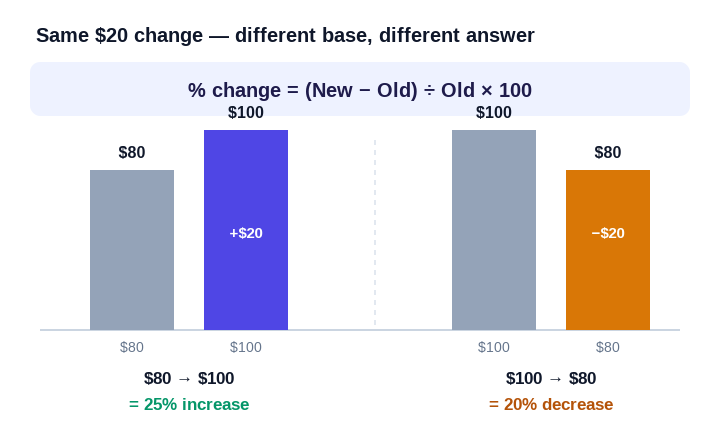
Percentage change = ((New value − Old value) ÷ Old value) × 100
A positive result is an increase; a negative result is a decrease (drop the minus sign when reporting it). Two multiplier shortcuts find a new value when the percentage is known:
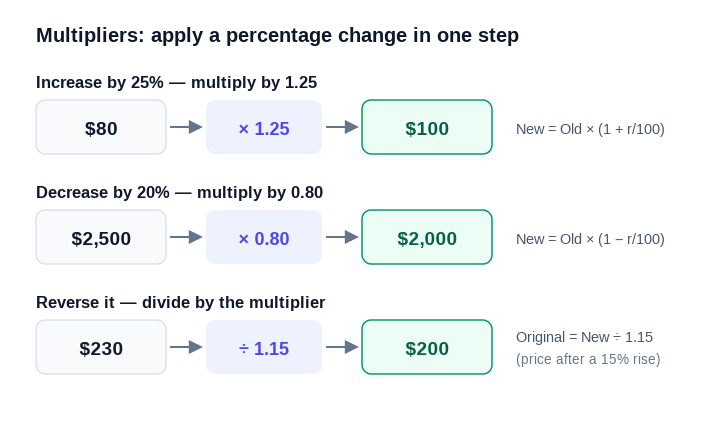
- Increase by r%: New value = Old value × (1 + r/100). A 25% increase means multiplying by 1.25.
- Decrease by r%: New value = Old value × (1 − r/100). A 20% decrease means multiplying by 0.80.
Multipliers are the fastest, safest method, because they never lose track of which value the percentage refers to. New to percentages? Start with how to calculate percentage, then return here.
How do I calculate the percentage increase/decrease between two numbers?
Learners ask this on the Godot Forum and in classrooms everywhere; it always takes three steps:
- Find the change: subtract the old value from the new value.
- Divide by the old value — never by the new one.
- Multiply by 100 and add the % sign.
Worked example — a price rise. A jacket rises from $80 to $100. The change is 100 − 80 = $20. Divide by the old value: 20 ÷ 80 = 0.25. Times 100: 25% increase — $20 is a quarter of $80, hence 25%, not 20%.
What is the correct way to calculate percent increase in math problems?
On Physics Forums, students often get the subtraction right but the division wrong — and that slip changes everything. The correct way: change first, then divide by the original value. The sign then tells the story by itself.
Worked example — a pay cut. A salary falls from $2,500 to $2,000. Change: 2,000 − 2,500 = −500. Divide by the original: −500 ÷ 2,500 = −0.20. Times 100: −20%, a 20% decrease. Same three steps as the rise; only the sign changed.
Percentage increase/decrease — what should be the denominator?
This is the core confusion behind a famous GMAT Club debate, and the answer never changes: the denominator is always the old, original value — the starting point the change is measured against.
Watch the base move. From $80 to $100 is a 25% increase, because 20 ÷ 80 = 0.25. Back from $100 to $80 is only a 20% decrease, because now 20 ÷ 100 = 0.20. Same $20, same two numbers, two percentages — because the base changed. Divide by the new value on the first trip and you get 20%, actually the answer to the return trip. That swap is the most common percentage error in homework, exams and headlines. Math Is Fun makes the same point in its Percentage Change lesson: compare the change with the old value.
Can someone tell me how to work out percentage increase and decrease? I forgot.
The Student Room asks this every exam season; here is the 30-second refresher. To apply a change — start value and percentage known, new value wanted — use the multiplier:
- Increase: add the percentage to 100, make it a decimal, multiply. Increase $80 by 25%: 125% = 1.25, and 80 × 1.25 = $100.
- Decrease: subtract the percentage from 100, make it a decimal, multiply. Decrease $2,500 by 20%: 80% = 0.80, and 2,500 × 0.80 = $2,000.
That is the whole method: find a change with (New − Old) ÷ Old × 100; apply a change with a multiplier.
Successive changes: why +20% then −20% is not zero
Successive percentages never add, because the second acts on a new base. Start with $100. A 20% increase gives 100 × 1.20 = $120. A 20% decrease now takes 20% of $120 — $24 — leaving 120 × 0.80 = $96. Net result: a 4% decrease, not zero: 1.20 × 0.80 = 0.96, or 96% of the original. The same repeated-growth logic powers our compound interest calculator and compound interest explained.
How to calculate annual increases in rent and leases
A Quora question that returns at every lease renewal: if rent rises by a fixed percentage yearly, what will you pay? Treat each year as its own increase on the new rent:
- Year 1: rent is $1,200, up 3.5%. Multiplier 1.035. 1,200 × 1.035 = $1,242.
- Year 2: the 3.5% now applies to $1,242, not $1,200. 1,242 × 1.035 = $1,285.47.
Two years of 3.5% is therefore not 7% of the original rent (that would be $1,284); it is $1,285.47, because the second increase also grows the first. For longer leases, keep multiplying by 1.035 yearly, or use the compound interest calculator with rent as principal.
Reverse percentage: finding the original value
Sometimes you know the price after the change and need the price before it. Do not subtract the percentage from the new price — it was taken of the original. Divide by the multiplier instead.
Worked example. After a 15% increase, a phone costs $230 — 115% of the original. So: Original = 230 ÷ 1.15 = $200. Check: 200 × 1.15 = 230. ✓ The classic mistake — taking 15% of $230 ($34.50) off to get $195.50 — is wrong: 15% of the original is not 15% of $230.
Percentage difference is not percentage change
Percentage change needs a direction: old value, then new value. Percentage difference compares two values when neither is “the original” — rival prices, two measurements. It divides by their average:
Percentage difference = (|A − B| ÷ Average of A and B) × 100
For 80 and 100: the difference is 20, the average is (80 + 100) ÷ 2 = 90, and 20 ÷ 90 × 100 ≈ 22.22%. The same pair gives three answers: 80 → 100 is a 25% increase, 100 → 80 a 20% decrease, and the percentage difference is about 22.22%. Use change for before-and-after; difference for equals.
Common mistakes
- Using the new value as the base. $80 → $100 divided by 100 gives 20% — the wrong trip's answer.
- Adding successive percentages. +20% then −20% nets −4%, and +3.5% twice nets more than +7%. Multiply the multipliers instead.
- Percentage points vs percent. A rate rising from 4% to 5% is up 1 percentage point — but a 25% increase in the rate itself (1 ÷ 4 = 0.25).
- Reversing with the same percentage. A 25% increase is undone by a 20% decrease, not another 25%.
- Subtracting the percentage in reverse problems. After a 15% rise to $230, the original is 230 ÷ 1.15 = $200, not $230 minus 15%.
Check your answers in seconds
The percentage calculator does all three jobs here: change between two numbers, applying an increase or decrease, and reverse percentages. If it disagrees with your hand calculation, check your denominator first.
Frequently asked questions
What is the correct way to calculate percent increase in math problems?
Subtract old from new, divide by the old (original) value, multiply by 100: (100 − 80) ÷ 80 × 100 = 25% increase for $80 → $100.
Percentage increase/decrease — what should be the denominator?
Always the old, original value. So $80 → $100 uses 80 as the denominator, and $100 → $80 uses 100.
How do I calculate the percentage increase/decrease between two numbers?
Use (New − Old) ÷ Old × 100. Positive is an increase, negative a decrease: $2,500 → $2,000 gives −20%, a 20% decrease.
Why do a 20% increase and a 20% decrease not cancel out?
The second percentage acts on a different base: $100 → $120, then 20% of $120 ($24) comes off, landing on $96 — a net 4% decrease.
How do I find the original price before a percentage increase?
Divide the final price by the multiplier: after a 15% increase to $230, the original was 230 ÷ 1.15 = $200.
What is the difference between percentage difference and percentage change?
Change divides by the old value and has a direction; difference divides by the average: between 80 and 100, 20 ÷ 90 ≈ 22.22%. Trap: 4% → 5% is +1 percentage point but a 25% relative increase.