Percentages
How to Calculate a Percentage of a Number (With Worked Examples)
Math Solver Free Team
Every percentage question in school is secretly the same question: part = percent × whole. Once you can spot the part, the percent, and the whole in a sentence, the arithmetic takes seconds. This guide works through the formula, the fastest mental shortcuts, and the examples students actually search for.
The one formula
To find P% of a number N: answer = (P ÷ 100) × N. Dividing by 100 turns the percent into a decimal (25% = 0.25), and multiplying applies it. So 25% of 80 = 0.25 × 80 = 20.
Worked examples
- 20% of 150: 0.20 × 150 = 30.
- 15% of 200: 0.15 × 200 = 30.
- 7.5% of 64: 0.075 × 64 = 4.8.
- 150% of 40: 1.5 × 40 = 60 — percents above 100 give answers bigger than the whole, which is correct.
The 10% shortcut (mental math)
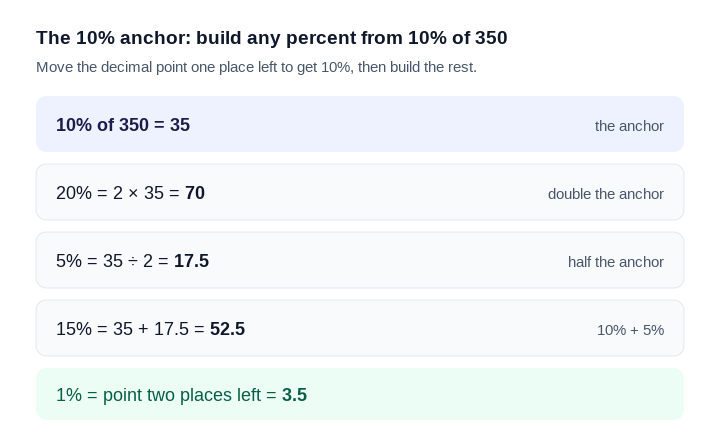
10% of anything is the number with the decimal point moved one place left: 10% of 350 = 35. From there, build what you need: 20% = double the 10% (70), 5% = half the 10% (17.5), 15% = 10% + 5% (35 + 17.5 = 52.5), 1% = move the point two places (3.5). Most classroom percentages are 1%, 5%, 10%, 15%, 20%, 25%, or 50% — all reachable from the 10% anchor in two steps.
The reverse question: what percent is X of Y?
Sometimes the part and the whole are given and the percent is missing: percent = (part ÷ whole) × 100. If you scored 45 out of 60, that is 45 ÷ 60 = 0.75, times 100 = 75%. Our percentage calculator handles this direction, percent change, and increase/decrease in one place.
Percentage points vs percent
A test average rising from 60% to 66% rose by 6 percentage points, but by 10 percent relative to where it started (6 ÷ 60 = 0.10). Mixing these up is the most common percentage mistake in news and homework alike.
Percent change: increases and decreases
The third great percentage question — after "percent of a number" and "what percent is X of Y" — is how much something changed: percent change = ((new − old) ÷ old) × 100. Always divide by the old value, because the change is measured against where you started.
Increase example: a game rises from $80 to $92. Change = 92 − 80 = 12. Percent change = 12 ÷ 80 = 0.15, so a 15% increase. Check it forwards: 15% of 80 is 12, and 80 + 12 = 92. ✓
Decrease example: a jacket falls from $250 to $200. Change = 200 − 250 = −50. Percent change = −50 ÷ 250 = −0.20, a 20% decrease. Note the trap: going back from $200 to $250 would be a 25% increase (50 ÷ 200), not 20% — percent changes are not symmetric, because the base changed.
Finding the whole when you know the part
Sometimes the part and the percent are given and the whole is missing: whole = part ÷ (percent ÷ 100). If 36 students passed and that is 45% of the class, the class size is 36 ÷ 0.45 = 80 students. Verify by running it forwards: 45% of 80 = 0.45 × 80 = 36. ✓ Whenever a percentage answer feels shaky, this forward check — recompute the part from your whole — settles it in seconds.
Discounts, tax, and tips: percentages with money
Discount: a $120 jacket is 25% off. The discount is 0.25 × 120 = $30, so you pay 120 − 30 = $90. Faster: paying 25% less means paying 75%, and 0.75 × 120 = $90 directly. Tax then applies to the discounted price, not the original: 8% tax on $90 is 0.08 × 90 = $7.20, so the total is $97.20. Two percentages in a row never share the same base — the tax base was the sale price.
Tip: 15% on a $46 bill, using the 10% shortcut: 10% of 46 = $4.60, 5% is half of that = $2.30, so the tip is 4.60 + 2.30 = $6.90 and the total is $52.90.
Fractions, decimals, and percents: one number, three costumes
These three forms are interchangeable, and fluency means converting without thinking: percent to decimal, divide by 100; decimal to percent, multiply by 100; fraction to decimal, divide top by bottom.
- 1/2 = 0.5 = 50%
- 1/4 = 0.25 = 25% · 3/4 = 0.75 = 75%
- 1/5 = 0.2 = 20% · 1/10 = 0.1 = 10%
- 1/8 = 0.125 = 12.5% · 3/10 = 0.3 = 30%
Going the other way, 0.625 as a fraction: 0.625 = 625/1000, and dividing top and bottom by 125 gives 5/8 — so 0.625 = 5/8 = 62.5%. Test scores, interest rates, and probability all switch costumes like this, so the conversion table above is worth memorising cold.
Common mistakes
- Dividing by the new value in percent change. The base is always the original (old) value. From 80 to 92 is +15%, not 12 ÷ 92 ≈ 13%.
- The decimal slip: 5% is 0.05, not 0.5 — 0.5 is 50%. A ten-times-too-big answer is the signature of this slip; sense-check the size.
- Adding chained percents. A 20% rise followed by a 20% fall is not "back to even": 100 → 120 → 96. Each percent acts on a new base.
- Percent of the wrong whole. "30% of students are girls, there are 12 girls" — the whole is the class, not the 12. Identify the whole before touching the formula.
- Forgetting the × 100 (or adding it twice). (part ÷ whole) gives a decimal like 0.75; the percent is 75%. If your percent comes out as 0.75% or 7,500%, the × 100 went missing or doubled.
Practice with a checker
Work each practice problem by hand first, then verify with the percentage calculator: 30% of 90, 12% of 250, 45% of 80, 8% of 175, 120% of 55. If a photo of the problem is easier, the photo math solver reads it and shows the steps. For the fraction side of the same skill, see fraction to percent conversions on the fraction calculator.
Frequently asked questions
How do you calculate a percentage of a number?
Divide the percent by 100 to get a decimal, then multiply by the number: 25% of 80 = 0.25 × 80 = 20.
What is 20% of 150?
0.20 × 150 = 30. Or use the 10% shortcut: 10% of 150 is 15, doubled is 30.
How do I find what percent one number is of another?
Divide the part by the whole and multiply by 100: 45 out of 60 is 45 ÷ 60 × 100 = 75%.
Can a percentage be more than 100%?
Yes. 150% of 40 is 60 — more than the whole — which happens whenever something grows beyond its original size.
How do I calculate percent change?
Subtract the old value from the new one, divide by the old value, and multiply by 100. From 80 to 92: (92 − 80) ÷ 80 × 100 = 15% increase. Always divide by the old value.
How do I work out a price after a discount?
Multiply the price by the share you still pay: 25% off $120 means paying 75%, and 0.75 × 120 = $90. Any sales tax is then calculated on the discounted $90, not the original price.