Grades & GPA
How to Calculate GPA: Formula, 4.0 Scale and a Worked Example
Math Solver Free Team

Your GPA (grade point average) compresses a whole term of grades into one number — and colleges, scholarships, and employers all read that number. The good news is that the calculation is simple once you see it: convert each letter grade to points, weight each course by its credits, and divide. This guide gives the full 4.0 scale, the exact formula, a complete semester worked out line by line, the difference between GPA and CGPA, and a realistic plan for raising yours. At the end, the GPA calculator can repeat the same maths for your real grades in seconds.
The 4.0 scale: letter grades to grade points
On the standard unweighted scale used by most US high schools and colleges, each letter grade is worth a fixed number of points:
- A+ = 4.0 · A = 4.0 · A− = 3.7
- B+ = 3.3 · B = 3.0 · B− = 2.7
- C+ = 2.3 · C = 2.0 · C− = 1.7
- D+ = 1.3 · D = 1.0 · D− = 0.7
- F = 0.0
Some schools do not use plus/minus grades; there, A = 4, B = 3, C = 2, D = 1, F = 0 exactly. Others treat A+ as 4.3. Always use your own school's table if it publishes one — but the method below never changes, only the numbers in the table.
The GPA formula
Each course contributes quality points = grade points × credits. A course's credits (or credit hours) measure how much class time it carries, so a 4-credit course counts more than a 1-credit course. The formula is:
GPA = total quality points ÷ total credits
That is all there is to it: add up (grade points × credits) for every course, add up the credits, and divide the first total by the second.
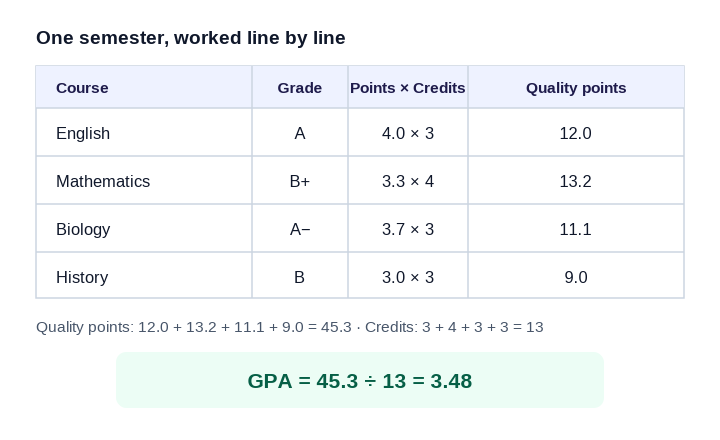
Worked example: one full semester, four courses
Suppose a student finishes the semester with these grades:
- English — A (4.0), 3 credits: 4.0 × 3 = 12.0 quality points
- Mathematics — B+ (3.3), 4 credits: 3.3 × 4 = 13.2 quality points
- Biology — A− (3.7), 3 credits: 3.7 × 3 = 11.1 quality points
- History — B (3.0), 3 credits: 3.0 × 3 = 9.0 quality points
- Add the quality points: 12.0 + 13.2 + 11.1 + 9.0 = 45.3.
- Add the credits: 3 + 4 + 3 + 3 = 13.
- Divide: 45.3 ÷ 13 = 3.4846…, which rounds to a GPA of 3.48.
Notice what the credits did: the B+ sat in the 4-credit course, so it pulled the average down more than the B in the 3-credit History course pulled it down. That weighting is the whole difference between a GPA and a plain average of grades.
Unweighted vs weighted GPA
If every course carried the same credit value, the formula collapses into a simple average of grade points. Four courses graded A, B, A, C would give (4.0 + 3.0 + 4.0 + 2.0) ÷ 4 = 13.0 ÷ 4 = 3.25. This is the unweighted GPA, capped at 4.0.
Many high schools also report a weighted GPA that rewards harder courses: honours classes often add 0.5 points and Advanced Placement (AP) or IB classes add 1.0 point, so an A in an AP course can count as 5.0 and a weighted GPA can exceed 4.0. Neither number is "the real one" — colleges usually recalculate both on their own scale — but you must know which one a transcript is showing before you compare it with anyone else's.
GPA vs CGPA: what is the difference?
GPA usually means one term: the semester or year just finished. CGPA (cumulative GPA) is the same formula applied to every course you have ever taken in the programme. You cannot average two term GPAs unless the terms carry equal credits — you must go back to totals.
Example: Semester 1 above produced 45.3 quality points over 13 credits (GPA 3.48). Suppose Semester 2 produces a 3.60 GPA over 14 credits, which is 3.60 × 14 = 50.4 quality points. The CGPA is (45.3 + 50.4) ÷ (13 + 14) = 95.7 ÷ 27 = 3.544…, or 3.54. Simply averaging 3.48 and 3.60 would give 3.54 as well here only because the credit loads are similar — with very different loads, the shortcut gives the wrong answer.
How to raise your GPA (with the maths shown)
Because CGPA is a weighted average of everything so far, each new term moves it less as your credit total grows. That is not discouraging — it is a planning tool. Suppose you hold a 3.20 CGPA over 60 completed credits and earn a 3.80 over the next 15 credits:
- Existing quality points: 3.20 × 60 = 192.0.
- New quality points: 3.80 × 15 = 57.0.
- New CGPA: (192.0 + 57.0) ÷ (60 + 15) = 249 ÷ 75 = 3.32.
One strong term lifted the CGPA by 0.12 — meaningful for scholarship cut-offs. The strategies that actually move the number follow from the formula: protect grades in high-credit courses first, because they carry the most weight; retake a failed course if your school replaces the grade, since swapping an F (0.0) for a B (3.0) in a 3-credit course adds 9 quality points; and front-load effort early in your degree, when every credit is a larger share of the total.
Common mistakes
- Averaging the percentages. GPA is built from letter-grade points, not from averaging 87%, 92%, and 78%. Convert each grade first.
- Ignoring credits. A plain average of the four grades in our worked example gives (4.0 + 3.3 + 3.7 + 3.0) ÷ 4 = 3.50 — close to 3.48, but wrong, and the gap grows when credit loads differ more.
- Treating an F as "no grade". An F contributes 0 quality points but its credits still count in the divisor. An A and an F in two 3-credit courses give (12 + 0) ÷ 6 = 2.0, not 4.0.
- Comparing weighted and unweighted numbers. A 4.4 weighted GPA and a 3.9 unweighted GPA can describe the same student.
- Rounding mid-calculation. Keep full precision until the final division, then round once to two decimal places.
How the GPA calculator helps
The GPA calculator does the conversion, weighting, and division for a whole semester at once, and lets you test "what if" scenarios: change one expected grade and watch the GPA move before you decide where to spend your study hours. It is also the quickest way to compute the target average you need next term to reach a CGPA goal — run the numbers, then work backwards to the grades required.
Frequently asked questions
How is GPA calculated?
Convert each letter grade to points on the 4.0 scale, multiply each course's points by its credits, add everything, and divide by the total credits: GPA = total quality points ÷ total credits.
What is a good GPA?
On a 4.0 scale, 3.0 is a solid B average, 3.5 and above is strong for most college and scholarship purposes, and 3.7+ is highly competitive. Standards vary by school and programme, so compare against your institution's requirements.
Does an F count in GPA?
Yes. An F earns 0.0 grade points, but its credits still count in the total-credits divisor, which is why a single F pulls a GPA down so sharply.
Can a GPA be higher than 4.0?
Only on a weighted scale, where honours or AP courses add bonus points (an AP A may count as 5.0). An unweighted GPA can never exceed 4.0.
What is the difference between GPA and CGPA?
GPA covers one term; CGPA (cumulative GPA) covers every term combined, calculated from total quality points and total credits across the whole programme — not by averaging term GPAs.
How much can one semester raise my CGPA?
It depends on how many credits you have already banked. A 3.80 term over 15 credits lifts a 3.20 CGPA built on 60 credits to 3.32. Early terms move the number most.