Math Tools
How to Use ChatGPT for Math — and When a Verified Solver Wins
Math Solver Free Team

Used well, ChatGPT is a patient tutor that never gets tired of your questions. Used carelessly, it is a confident classmate copying homework in beautiful handwriting — sometimes the copying is wrong. This guide shows how to use ChatGPT for math the productive way: the prompts that make it teach instead of tell, the failure modes to expect, and the short verification routine that means you never hand in an answer nobody has checked.
What is ChatGPT actually good at in math?
- Explaining concepts. "Explain the chain rule like I'm 15, then give me one easy example" is the kind of request it handles brilliantly.
- Translating word problems. Paste a word problem and ask it to set up the equation without solving it. Turning words into algebra is language work — its home turf.
- Generating practice. "Make five quadratic equations that factorise nicely, answers hidden" gives you a personal problem set in seconds.
- Unsticking you. A hint at 11pm the night before a test, a different viewpoint on a stuck step, a mnemonic for a formula — genuinely useful.
Where does ChatGPT go wrong with math?
ChatGPT predicts what a solution should look like; it does not calculate the way a math engine does. Expect trouble with long arithmetic chains, nested fractions, problems where one early slip poisons every later line, and anything where the answer needs to be exact rather than plausible. Its most dangerous habit is tone: a wrong answer arrives in the same calm, well-formatted voice as a right one. Treat every ChatGPT answer as a draft — often excellent, never self-verified.
The worked example: a quadratic, checked properly
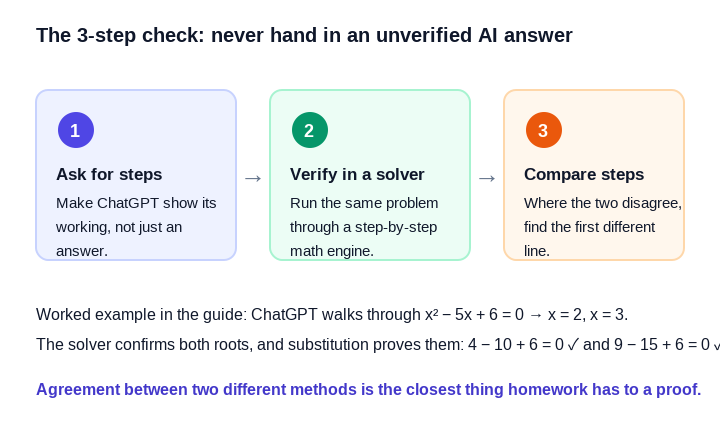
Ask ChatGPT to solve x² − 5x + 6 = 0 and it will likely factorise: two numbers that multiply to 6 and add to −5 are −2 and −3, so (x − 2)(x − 3) = 0 and x = 2 or x = 3. Good — now verify instead of trusting. Substituting x = 2: 4 − 10 + 6 = 0 ✓. Substituting x = 3: 9 − 15 + 6 = 0 ✓. And running the same equation through our quadratic equation solver returns the same two roots with the working shown. Two independent methods agreeing is the closest thing homework has to proof.
How do you verify a ChatGPT math answer in 3 steps?
- Ask for steps, not just the answer. A solution with visible working can be checked; a bare number cannot.
- Re-solve it in a step-by-step solver. Type the problem into a free math solver or the topic calculator and compare results.
- Substitute or sanity-check. Put the answer back into the original problem, or estimate whether the size makes sense. If the two methods disagree, compare steps and find the first line where they split — that line is the lesson.
When does a verified solver beat ChatGPT?
- Exact answers matter: exam-style questions, graded homework, anything with fractions or roots where "approximately" loses marks.
- The problem is pure computation: derivatives, integrals, systems of equations, matrix work — hand these to the engine built for them.
- You need the same answer twice: engines are deterministic; ask a chatbot twice and the working may change.
- The problem is in a photo: our photo math solver reads printed problems with on-device OCR and solves them with the engine — the photo never leaves your device. For the honest background to this whole comparison, read our guide on AI math solver vs step-by-step solver.
And keep one boundary straight: using ChatGPT to learn — explanations, hints, practice, checking your own work — is legitimate study. Submitting its raw output as your work is your school's call, not this guide's, and most schools call it cheating. The verification habit above also protects you there: work you have checked and understood is work you can defend. Students at many schools follow written acceptable-use policies for AI; when in doubt, ask your teacher what is allowed.
Frequently asked questions
Can ChatGPT solve math problems correctly?
Often, yes — especially routine textbook problems and anything where its job is explanation or setting up an equation. Its failure rate climbs on long multi-step arithmetic and problems needing exact answers, which is exactly why verification matters: a checked ChatGPT answer is a reliable answer.
How do I get ChatGPT to show its working?
Ask directly: "Solve this step by step, one line at a time, and state which rule you use at each step." Then ask the most powerful follow-up in maths: "Substitute your answer back into the original problem to check it." It still will not truly verify the way an engine does, but visible steps let you verify — or catch the slip yourself.
Is using ChatGPT for math homework cheating?
It depends on how you use it and what your school allows. Using it as a tutor — explanations, hints, extra practice, checking your own finished work — is how most teachers would want it used. Copying its answers as your own submission is academic dishonesty in most schools. The safe rule: if you could not explain the solution afterwards, you did not do the homework.
What is the best prompt for math help?
"Act as my tutor, not my answer key. I am stuck on this problem: [problem]. Give me a hint for the first step only, and wait for my attempt before showing more." Tutoring prompts produce learning; answer prompts produce copying — and copying collapses at the exam, where no chatbot is allowed.
When should I skip ChatGPT and use a solver directly?
Whenever the task is a calculation rather than a conversation: solving equations for a grade, differentiating, integrating, simplifying exact fractions, or checking answers you plan to submit. A deterministic solver gives exact, repeatable, checkable results — the three things homework answers need most.