Math Tools
AI Math Solver vs Step-by-Step Solver: What Each Actually Does
Math Solver Free Team
Search for help with a maths problem and you will meet two very different machines wearing similar labels. An AI math solver is usually a chatbot — a large language model that writes out a plausible-looking solution in words. A step-by-step solver is a math engine: software that applies the actual rules of algebra, in order, and shows each transformation. Both can be useful. They fail in completely different ways, and knowing which one produced your answer tells you how much you should trust it.
How does a step-by-step solver actually work?
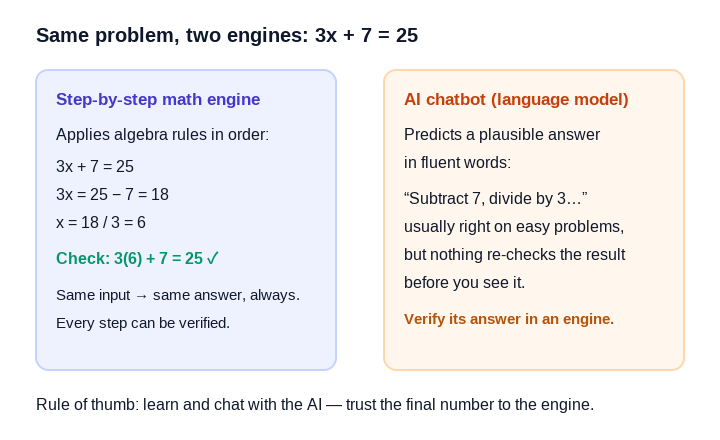
A step-by-step solver runs a deterministic math engine — the same input always produces the same output, because the software follows fixed rules instead of guessing. Give it 3x + 7 = 25 and it subtracts 7 from both sides (3x = 18), then divides both sides by 3 (x = 6). It can then prove the answer by substitution: 3(6) + 7 = 25 ✓. Nothing in that chain is a matter of style or probability — each line follows from the previous one by a named rule, and any line can be checked. The solver on this site works exactly this way: a real math engine computes the answer and writes out the steps it used. It is not AI, and it does not pretend to be.
How does an AI math solver work instead?
A chatbot-style AI math solver predicts text. Trained on enormous amounts of written mathematics, it produces the solution that looks most likely given the problem — fluent, well-formatted, and usually right on routine problems. But prediction is not calculation. The model does not run the algebra rules; it imitates the appearance of someone running them. On multi-step problems — nested fractions, long division, careful sign handling — it can drop a minus sign or invent a step that reads beautifully and is simply wrong, and it presents the wrong answer with the same confidence as a right one. Nothing inside the model re-checks the final number.
AI math solver vs step-by-step solver: the honest comparison
- How answers are produced: the AI predicts plausible text; the engine applies rules.
- Repeatability: ask the AI twice and you may get two different solutions; the engine returns the identical result every time.
- Verification: the engine can substitute its answer back into the original problem and prove it; the chatbot's answer is verified by nothing but its own wording.
- Understanding your question: the AI wins here — describe a word problem in your own words and it will usually grasp what is being asked. The engine needs the problem in mathematical form.
- Explaining the idea: the AI explains concepts conversationally and can rephrase until it clicks. The engine's steps are exact but terse.
- Cost and access: both exist in free forms; accuracy, not price, is the real dividing line.
When should you use each one?
Use the AI to understand: "explain why we flip the inequality sign", "turn this word problem into an equation", "give me a hint, not the answer". Use the step-by-step solver to compute and to check: exact answers, homework verification, anything where a single wrong digit costs marks. The strongest routine uses both — let the AI translate the word problem into an equation, then let the engine solve it and prove the result. Our word problem calculator covers the most common word-problem families with that same engine discipline, and the photo math solver reads printed problems with on-device OCR and feeds them to the engine — your photo never leaves your device.
How do you verify an AI math answer?
- Substitute back. Put the answer into the original equation. If both sides match, the answer is right — this check never lies.
- Re-solve in an engine. Type the same problem into a step-by-step math solver and compare final answers.
- Compare the steps, not just the result. Where the two solutions first disagree is where one of them went wrong — usually a sign or an arithmetic slip.
- Sanity-check the size. A jacket discounted 20% from $80 cannot cost $96. Estimation catches a surprising share of AI errors.
What about AI tools that claim to solve from a photo?
Photo solving has two halves: reading the problem (OCR — a well-solved pattern-recognition task) and solving it (the part that matters). An app can read your handwriting or print perfectly and still solve the problem with an unverified prediction. Ask one question of any photo tool: after it reads my problem, what produces the answer — a math engine or a language model? This site's photo solver uses a math engine, so its answers come with checkable steps. For the bigger picture of how our tools are built and accuracy-checked, see our methodology page, and for the textbook treatment of the algebra itself, the free OpenStax Intermediate Algebra is hard to beat.
Frequently asked questions
Is a step-by-step solver the same as an AI math solver?
No. A step-by-step solver computes with a deterministic math engine that applies algebra rules in a fixed order; an AI math solver is typically a language model predicting what a solution should look like. The engine's steps can be verified line by line; the AI's output cannot verify itself.
Why do AI math solvers give wrong answers so confidently?
Because confidence is part of the text style they learned, not a measurement of correctness. A language model produces the most plausible-looking continuation whether the underlying arithmetic is right or wrong, and it has no internal step that checks the final number.
Can I trust an AI answer if I verify it?
Yes — verification changes the situation completely. If the AI's answer survives substitution into the original problem, or matches a math engine's result, you are no longer trusting the AI; you are trusting the check. That is the safe way to use any AI for maths.
Is the solver on this site AI?
No. It is a deterministic math engine: the same problem always gets the same worked solution, and answers are exact rather than predicted. We think that honesty is the point — you should know which kind of machine produced your answer.
Which is better for word problems?
For understanding what a word problem is asking, a chatbot is genuinely helpful — it reads natural language well. For solving the resulting equation, the engine is safer. Use the AI to translate, the engine to solve and prove.