Unit Conversion
120 Minutes to Hours: The Answer and How to Convert
Math Solver Free Team
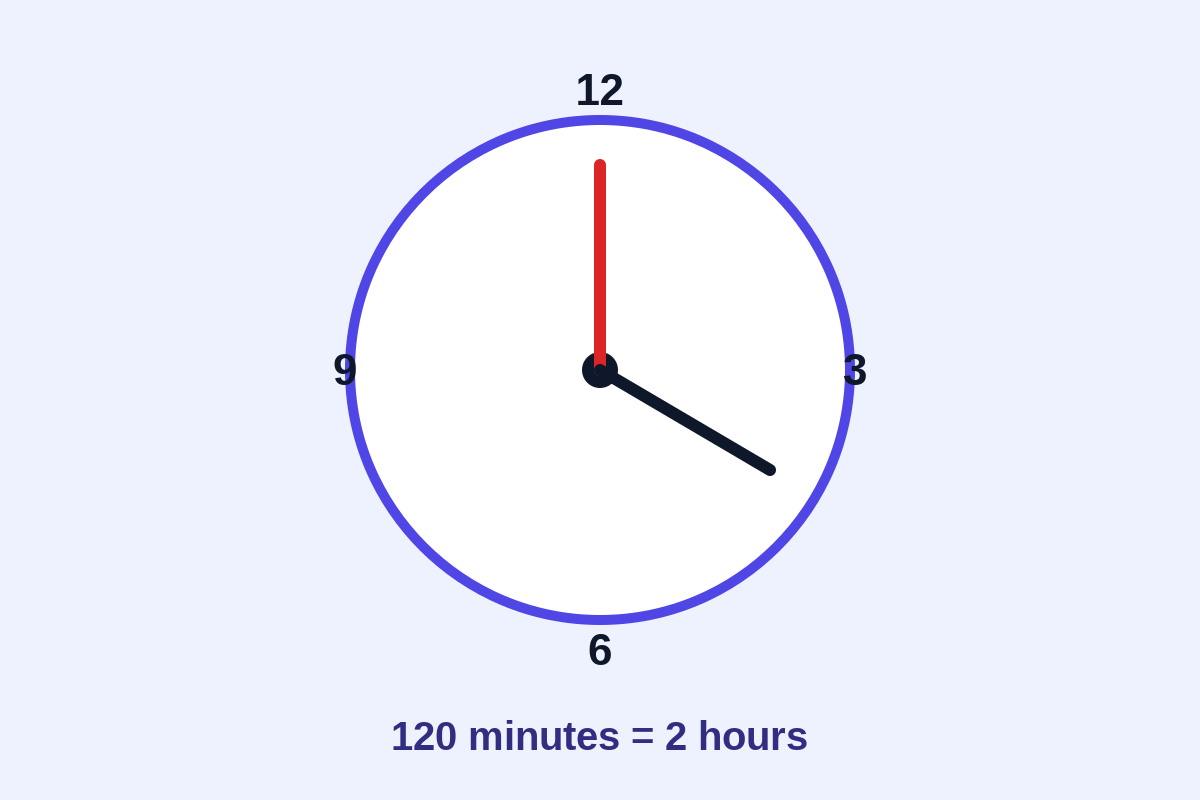
120 minutes is exactly 2 hours. The conversion is one division: since 1 hour contains 60 minutes, divide the minutes by 60 — 120 ÷ 60 = 2. This page shows the working in full, gives a minutes-to-hours table for the values people look up most, answers the related ways the same question gets asked (in hours and minutes, as a decimal, as a fraction of a day), and links the converter that handles any other value.
How to convert 120 minutes to hours
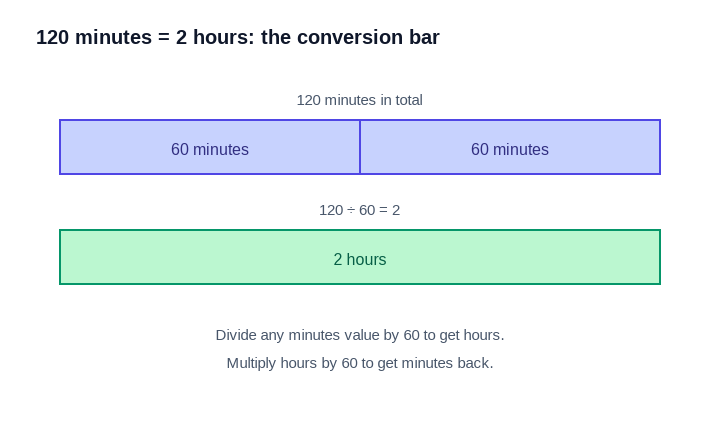
Every minute-to-hour conversion uses the same step, because the relationship never changes: 1 hour = 60 minutes. To turn minutes into hours, divide by 60. For 120 minutes: 120 ÷ 60 = 2, so 120 minutes = 2 hours. The reverse direction multiplies instead: 2 hours × 60 = 120 minutes, which confirms the answer. If a division does not come out whole, the remainder is leftover minutes — 150 minutes = 2 hours with 30 minutes left over, written 2 hours 30 minutes or 2.5 hours.
Minutes to hours conversion table
15 minutes = 0.25 hours (a quarter of an hour). 30 minutes = 0.5 hours (half an hour). 45 minutes = 0.75 hours (three quarters). 60 minutes = 1 hour. 90 minutes = 1.5 hours. 120 minutes = 2 hours. 180 minutes = 3 hours. 240 minutes = 4 hours. 360 minutes = 6 hours. Each row is the same division by 60, so the pattern is easy to extend: 200 minutes = 3 hours 20 minutes, because 200 ÷ 60 = 3 with a remainder of 20.
The same question, asked other ways
How many hours is 120 minutes? 2 hours — the division above. 120 minutes in hours and minutes: 2 hours 0 minutes, since 120 divides exactly. What is 120 minutes as a decimal? 2.0 hours; decimals matter when the minutes do not divide evenly — 90 minutes is 1.5 hours, 45 minutes is 0.75 hours. How long is 120 minutes in days? A day has 1,440 minutes (24 × 60), so 120 minutes is 120 / 1,440 = 1/12 of a day, about 0.083 days. And in seconds? 120 × 60 = 7,200 seconds.
Convert any minutes to hours
For values outside the table, the unit converter has a dedicated Time category that converts minutes to hours (and seconds, days and weeks) in both directions — type the value and read the result, no formula to remember. The general method behind conversions of every kind — multiply or divide by the unit relationship, and keep track of which direction you are going — is covered in our guide to converting units.
Where 120 minutes shows up
Two hours is a standard block: a long film, a football match with half-time and stoppages runs about 120 minutes of clock time, many exams are timetabled at exactly 2 hours, and a 120-minute timer is the classic setting for focused work sessions and slow cooking. Knowing that 120 minutes and 2 hours are the same duration — not approximately, but exactly — is what makes timetables, recipes and schedules written in the other unit easy to read at a glance.
Three more conversions, worked in full
The divide-by-60 method does not care which number you feed it. 95 minutes: 95 ÷ 60 = 1.5833… hours as a decimal — and as a clock duration, 95 = 60 + 35, so 95 minutes is 1 hour 35 minutes. 150 minutes: 150 ÷ 60 = 2.5 hours exactly, which in clock form is 2 hours 30 minutes — the running time of a long film or a full football broadcast with build-up and analysis. 1,000 minutes: 1,000 ÷ 60 = 16.666… hours; the whole part is 16 hours and the fractional 0.666… × 60 = 40 minutes, so 1,000 minutes is 16 hours 40 minutes — most of a waking day. Notice the two-step rhythm for clock form: divide for the decimal, then multiply the fraction back by 60 for the leftover minutes. The unit converter on this site runs the same conversion instantly for any value.
Decimal hours are not clock hours
The commonest real-world stumble with this conversion is reading a decimal as if it were a clock. 1.5 hours is 1 hour 30 minutes — not 1 hour 50 minutes — because the .5 is five tenths of an hour, and a tenth of an hour is 6 minutes, not 10. Timesheets, payroll systems and project trackers quote decimal hours (7.5 hours for a working day, 0.25 for a quarter hour) precisely because decimals add and multiply cleanly, while clocks and timetables keep the base-60 form because it matches how time is displayed. Converting between the two is the whole skill: hours to minutes, multiply by 60; minutes to hours, divide by 60; and when a decimal appears, convert its fraction separately — 2.75 hours is 2 hours plus 0.75 × 60 = 45 minutes, i.e. 2 hours 45 minutes, never 2 hours 75 minutes.