Math Guides
Scientific Notation Explained: Convert, Multiply, Divide
Math Solver Free Team

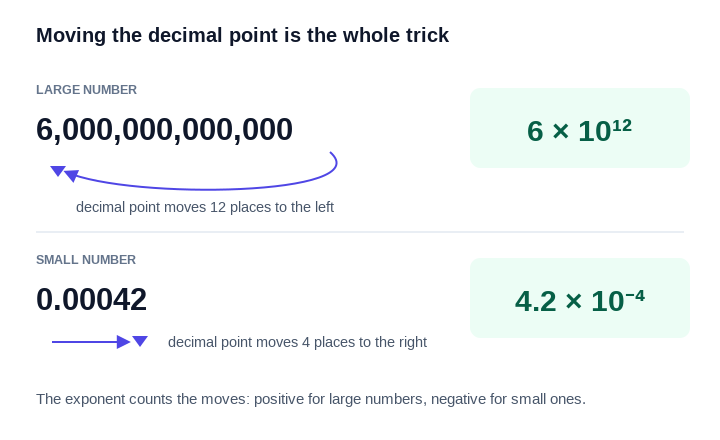
Scientific notation is a short way to write numbers too large or too small for ordinary decimal form. Instead of counting long strings of zeroes in 6,000,000,000,000 or 0.00042, you write one tidy product: a number between 1 and 10 multiplied by a power of 10. This guide explains what the form means, how to convert large and small numbers into it and back, how to multiply, divide, add and subtract, and how to compare sizes at a glance — answering, word for word, the questions students keep posting on math help forums.
What is scientific notation? The a × 10^n form
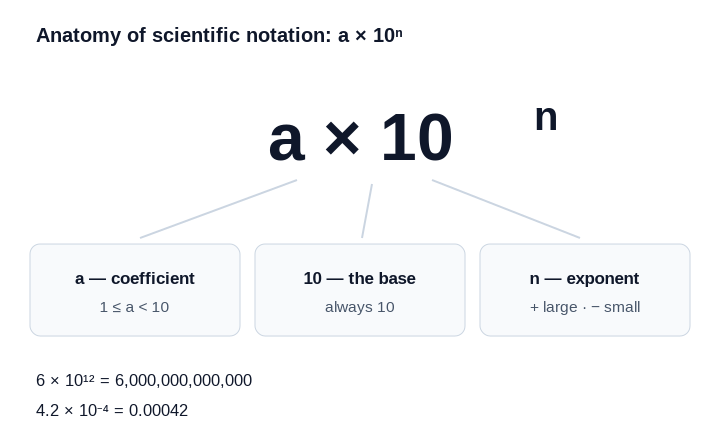
A number is in scientific notation when it is written as a × 10^n, where the coefficient a satisfies 1 ≤ a < 10 and the exponent n is an integer. Every such number has exactly three parts:
- The coefficient (a): a number with exactly one non-zero digit before the decimal point, like 6, 4.2 or 9.3, carrying the original number's meaningful digits.
- The base: always 10 — moving a decimal point is the same as multiplying or dividing by 10.
- The exponent (n): an integer that records the size of the number: positive means large, negative means small (between 0 and 1), and 0 means the number is already between 1 and 10.
Why bother? Three reasons. First, compactness: 6 × 10^12 replaces thirteen digits. Second, honesty: the coefficient shows exactly which digits are significant, with no decorative zeroes. Third, arithmetic: multiplying and dividing become simple exponent rules — practise them with our exponent calculator. Calculators show the same idea as E-notation: 6E12 means 6 × 10^12, and 4.2E-4 means 4.2 × 10^-4. For a visual introduction with an interactive converter, see the scientific notation page at Math is Fun.
How do you do scientific notation?
A seventh grader asked this on Ask Professor Puzzler. The honest answer: there is only one routine, used in both directions:
- Move the decimal point until exactly one non-zero digit stands to its left. The digits that remain form the coefficient a.
- Count the places you moved. That count is the size of the exponent.
- Choose the sign from the size of the original number: 10 or more means positive; smaller than 1 means negative.
Then check: the coefficient must satisfy 1 ≤ a < 10, and expanding your answer must return the number you started with.
Write 6,000,000,000,000 in scientific notation
This Free Math Help Forum question looks trivial — yet the poster got stuck because the answer seems to throw digits away. Work it through:
- Place the decimal after the first non-zero digit: 6,000,000,000,000 becomes 6. — the coefficient is simply 6.
- Count the places the decimal point moved: from the end of the number to just after the 6 is 12 places.
- The original number is huge, so the exponent is positive: 6,000,000,000,000 = 6 × 10^12.
Now the confusion: where did all the zeroes go? They were not dropped or lost — they are counted: the exponent 12 is the record of those twelve places. Check by expanding: 10^12 is 1,000,000,000,000, and 6 × 1,000,000,000,000 = 6,000,000,000,000. Nothing vanished. Zeroes disappear from view only when they carry no information — when every digit after the first is zero. A later non-zero digit stays: 6,400,000,000,000 = 6.4 × 10^12, and 93,000,000 = 9.3 × 10^7 (the decimal moves 7 places and the 3 is kept). To shorten a long coefficient, round it deliberately with the rounding calculator rather than deleting digits.
Converting small numbers: 0.00042 in scientific notation
Small numbers use the same routine with one change of sign. Take 0.00042:
- Move the decimal point right, past the zeroes, until it sits after the first non-zero digit: 0.00042 becomes 4.2.
- Count the moves: 4 places.
- The original number is smaller than 1, so the exponent is negative: 0.00042 = 4.2 × 10^-4.
Check by expanding: 10^-4 = 0.0001, and 4.2 × 0.0001 = 0.00042. The logic: moving the decimal right made the coefficient bigger (0.00042 grew into 4.2), so the power of 10 must shrink the value back — exactly what a negative exponent does.
Negative exponents and scientific notation: why the arrows seem to point the wrong way
An Algebra.com poster described a classic tangle: the book says a positive exponent moves the decimal point right, yet its arrows for small numbers point left. The confusion comes from mixing up two opposite journeys:
- Journey 1 — building the notation (standard form → scientific notation). For a small number like 0.00042, you move the decimal point right to build the coefficient 4.2, and you record a negative exponent, because the power of 10 must undo that growth.
- Journey 2 — expanding the notation (scientific notation → standard form). For 4.2 × 10^-4, you move the decimal point left 4 places to recover 0.00042. Here a negative exponent really does mean “move left”, a positive one “move right”.
Both journeys are correct; they are reverses of each other, so the same sign looks contradictory if the direction is not stated. The reliable fix is to stop reading the exponent as an arrow and read it as a size label first: a positive exponent always labels a large number (10^3 = 1,000), a negative exponent always labels a small number (10^-3 = 0.001), no matter which way any arrow points. Decide the size first, and the direction of every move follows automatically. You can verify any power instantly on a scientific calculator.
Converting back to standard form
To expand, run Journey 2: move the coefficient's decimal point by the exponent — right for a positive exponent, left for a negative one — filling any gaps with zeroes. Example: 7.2 × 10^3. The exponent 3 is positive, so move the decimal in 7.2 three places right: 7.2 → 72 → 720 → 7,200. So 7.2 × 10^3 = 7,200. Going the other way, 4.2 × 10^-4 moves the decimal four places left and returns 0.00042 — exactly the check to always run.
Perform the indicated operations. Write the result in scientific notation
For each operation, treat the coefficients and the powers of 10 separately, then tidy the result so the coefficient again satisfies 1 ≤ a < 10.
Multiplying: multiply the coefficients, add the exponents
Compute (3 × 10^5)(2 × 10^4). Multiply the coefficients: 3 × 2 = 6. Add the exponents: 5 + 4 = 9. Result: 6 × 10^9. Warning: if the coefficient product reaches 10 or more, renormalise — move its decimal one place left and raise the exponent by 1. So (4 × 10^5)(3 × 10^4) first gives 12 × 10^9; shifting gives the proper form, 1.2 × 10^10.
Dividing: divide the coefficients, subtract the exponents
Compute (8 × 10^9) ÷ (4 × 10^3). Divide the coefficients: 8 ÷ 4 = 2. Subtract the exponents: 9 − 3 = 6. Result: 2 × 10^6. If the division leaves a coefficient below 1 — say 2 ÷ 8 = 0.25 — renormalise the other way: move the decimal one place right and lower the exponent by 1, turning 0.25 × 10^6 into 2.5 × 10^5.
Adding and subtracting: align the exponents first
Addition has no shortcut: you can only add coefficients that share the same power of 10. Compute 5 × 10^6 + 3 × 10^5. First rewrite the smaller term with the larger exponent: 3 × 10^5 = 0.3 × 10^6 (coefficient ÷ 10 as the exponent grows by 1). Now add: 5 × 10^6 + 0.3 × 10^6 = 5.3 × 10^6. Subtraction works identically — align, then subtract. Never add the exponents themselves; that belongs to multiplication only.
Comparing sizes in scientific notation
Comparison is where the notation earns its keep: size is visible at a glance. For positive numbers, compare the exponents first: the larger exponent wins outright, whatever the coefficients say. Compare coefficients only when the exponents tie. Example: which is larger, 9.3 × 10^7 or 1.5 × 10^8? Although 9.3 looks bigger than 1.5, the exponents decide it — 8 beats 7, so 1.5 × 10^8 is the larger number. With negative exponents the same rule holds but feels reversed: 4.2 × 10^-4 is larger than 7.5 × 10^-7, because −4 is greater than −7. Each exponent step means a factor of 10 in size, so an exponent difference of 3 means roughly a thousand times.
Where scientific notation is used in real life
Astronomy runs on it: the distance from the Earth to the Sun is about 1.5 × 10^8 km (150,000,000 km), or about 9.3 × 10^7 miles, and light itself travels at roughly 3 × 10^8 metres per second. Physics and chemistry use the small end just as heavily: a bacterium is about 2 × 10^-6 m long and a hydrogen atom about 1 × 10^-10 m across — unreadable as decimals. Because these quantities are usually measured in metric units, our sibling guide on how to convert units pairs with this one: convert the unit first, then express the result in scientific notation.