Algebra
How to Factor Quadratic Equations Step by Step
Math Solver Free Team
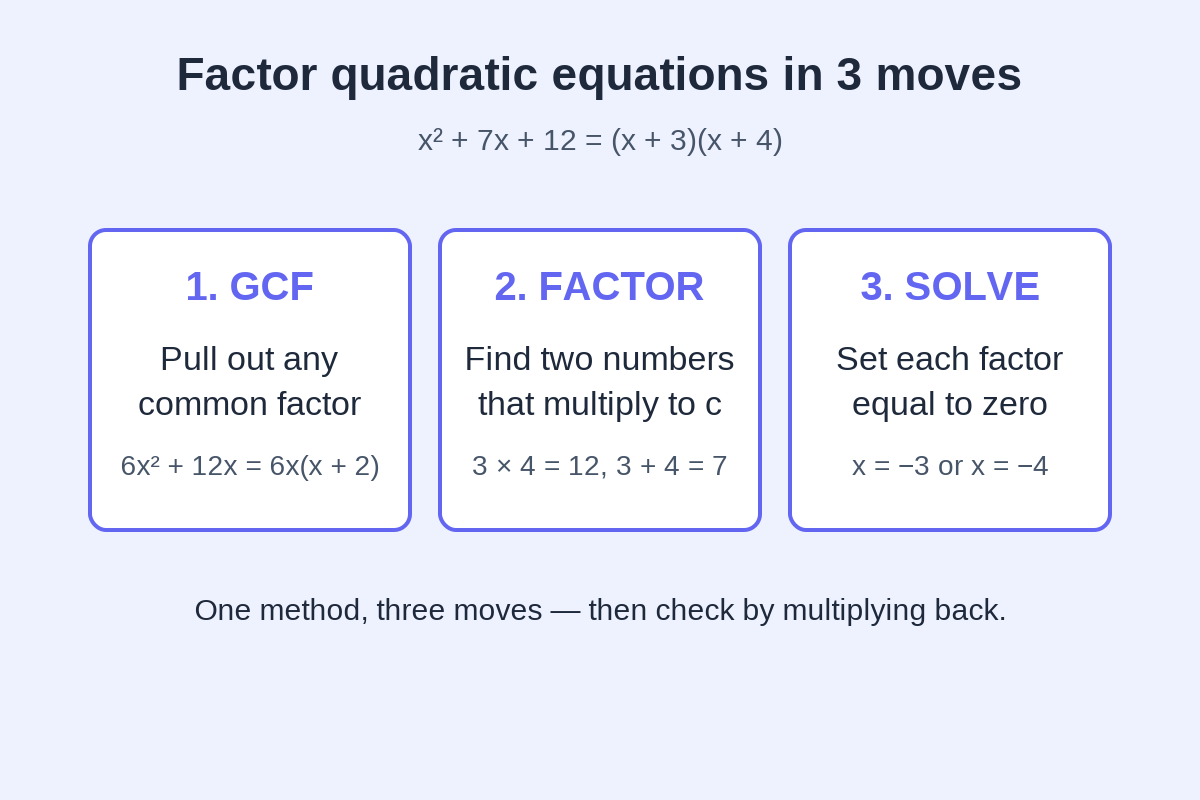
Learning how to factor quadratic equations turns a frightening-looking x² equation into two simple linear equations you can solve in seconds. Factoring means rewriting a quadratic as a product of two brackets — and once it is written that way, the answers fall out almost for free. This guide covers each step: common factor, trinomials with a = 1, the AC method, and the two special patterns.
First, write the equation in standard form: ax² + bx + c = 0, with zero on one side. Then work through the steps.
What does it mean to factor a quadratic equation?
To factor a quadratic equation is to rewrite it as a product of two linear factors. The equation x² + 7x + 12 = 0, for example, factors as (x + 3)(x + 4) = 0. Multiply the brackets back out and you get x² + 7x + 12 again — but the factored form is far more useful, because if a product equals zero, at least one factor must be zero. That is the zero-product property: from (x + 3)(x + 4) = 0 it gives x = −3 or x = −4.
The 5-step method for factoring quadratic equations
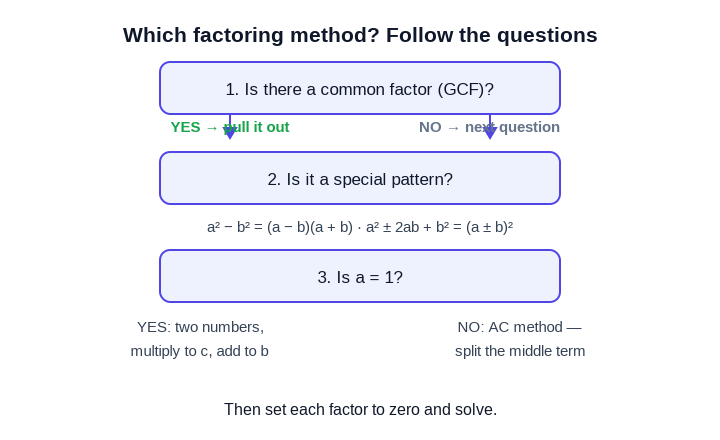
Every quadratic can be factored with the same five moves, in this order:
- Write it in standard form ax² + bx + c = 0, with zero on one side.
- Factor out the greatest common factor (GCF) if every term shares one.
- Look for a special pattern — a difference of squares or a perfect square trinomial.
- Factor the trinomial: if a = 1, find two numbers that multiply to c and add to b; if a is not 1, use the AC method.
- Set each factor equal to zero and solve — then check by multiplying back.
Work the steps in order. The flowchart above shows the same decision path at a glance.
Step 1: Factor out the GCF first
Check whether every term shares a common factor — a number, a variable, or both — and pull it out first: it shrinks the numbers you work with, and forgetting it leaves an answer that is correct but not fully factored. Example: 6x² + 12x = 6x(x + 2), so 6x² + 12x = 0 gives x = 0 or x = −2. Note that x = 0 is a genuine solution, so never throw the GCF away.
Step 2: Factor trinomials when a = 1
When the coefficient of x² is 1, factoring x² + bx + c comes down to one question: which two numbers multiply to c and add to b? Then x² + bx + c = (x + p)(x + q). If c is positive, p and q take the sign of b; if c is negative, they have opposite signs.
Example: Factor x² + 7x + 12. Two numbers that multiply to 12 and add to 7 are 3 and 4, so x² + 7x + 12 = (x + 3)(x + 4), giving x = −3 or x = −4.
Step 3: Factor trinomials when a is not 1 — the AC method
When the leading coefficient a is not 1, the two numbers must multiply to a × c (not just c) and add to b. This is the AC method: once you have the pair, split the middle term and factor by grouping.
Example: Factor 2x² + 7x + 3. Here a × c = 6, and two numbers that multiply to 6 and add to 7 are 6 and 1. Split the middle term: 2x² + 6x + x + 3. Group: (2x² + 6x) + (x + 3) = 2x(x + 3) + 1(x + 3). Both groups share (x + 3), so factor it out: (x + 3)(2x + 1). Then x = −3 or x = −1/2.
Special patterns: difference of squares and perfect squares
Two patterns appear so often that spotting them is worth real exam time. The difference of squares: a² − b² = (a − b)(a + b), so x² − 25 = (x − 5)(x + 5). A sum of squares, a² + b², does not factor over the real numbers.
The perfect square trinomial: a² + 2ab + b² = (a + b)² and a² − 2ab + b² = (a − b)². The first and last terms are squares and the middle term is twice the product of their roots: x² + 10x + 25 = (x + 5)².
| Pattern | Form | Factored form | Example |
|---|---|---|---|
| Difference of squares | a² − b² | (a − b)(a + b) | x² − 25 = (x − 5)(x + 5) |
| Perfect square (+) | a² + 2ab + b² | (a + b)² | x² + 10x + 25 = (x + 5)² |
| Perfect square (−) | a² − 2ab + b² | (a − b)² | x² − 12x + 36 = (x − 6)² |
Check your answers: substitute back in
Always substitute both answers into the original equation: for x² − 5x − 14 = 0, the roots 7 and −2 check out (7² − 5 × 7 − 14 = 0 ✓). If a factor is repeated, as in (x + 5)² = 0, there is one distinct solution, x = −5 — a double root. The quadratic equation solver shows the same steps for any equation, and the factoring calculator checks your factoring.
Which factoring method should you use?
Find your shape in the table, then follow the method beside it.
| What you see | Method to use |
|---|---|
| Every term shares a factor | Pull out the GCF first |
| Two terms, one square minus another | Difference of squares: a² − b² = (a − b)(a + b) |
| Three terms, first and last are squares | Perfect square trinomial |
| Three terms, a = 1 | Two numbers that multiply to c and add to b |
| Three terms, a is not 1 | AC method: multiply to a × c, add to b, split and group |
| Nothing factors | Quadratic formula / completing the square |
That last row matters: not every quadratic factors with integers. When the numbers refuse to work, switch methods — our guide on how to solve quadratic equations step by step covers the quadratic formula and completing the square, and when to use the quadratic formula explains how to choose.
5 common mistakes when factoring quadratic equations
- Forgetting the GCF. x² + 6x is x(x + 6), not (x + 6)(x).
- Getting the signs wrong. In (x − 7)(x + 2), the minus belongs to 7. Multiply back to catch slips.
- Stopping too early. 3(x² − 4) is not fully factored — the answer is 3(x − 2)(x + 2).
- Skipping the check. Substitute each solution back in. Two minutes of checking saves the whole question.
Practice problems (with answers)
Factor each one fully, then solve it.
- x² + 9x + 20 = 0
- x² − 3x − 28 = 0
- 2x² + 5x − 12 = 0
- 9x² − 16 = 0
- 4x² + 12x + 9 = 0
Answers: 1) x = −4 or x = −5. 2) x = 7 or x = −4. 3) (x + 4)(2x − 3) = 0, so x = −4 or x = 3/2. 4) x = 4/3 or x = −4/3. 5) x = −3/2 (double root). The equation solver with steps walks through any of these line by line. For more worked examples, GeeksforGeeks explains solving quadratics by factoring.
Frequently asked questions
How do you factor quadratic equations step by step?
Standard form first, then factor out any common factor, check for special patterns, and factor the trinomial — two numbers that multiply to c and add to b when a = 1, or the AC method when a is not 1. Then set each factor to zero.
What if a quadratic cannot be factored?
Not every quadratic factors with integers — x² + x + 1 is one example. Then use the quadratic formula or completing the square. A negative discriminant (b² − 4ac < 0) means no real solutions.
How do you factor a quadratic when a is not 1?
Use the AC method: find two numbers that multiply to a × c and add to b, split the middle term, and factor by grouping. For 2x² + 7x + 3, the pair 6 and 1 gives (x + 3)(2x + 1).
What is the difference of squares?
It is the pattern a² − b² = (a − b)(a + b): one square minus another. Example: x² − 25 = (x − 5)(x + 5).
How do you check your factoring?
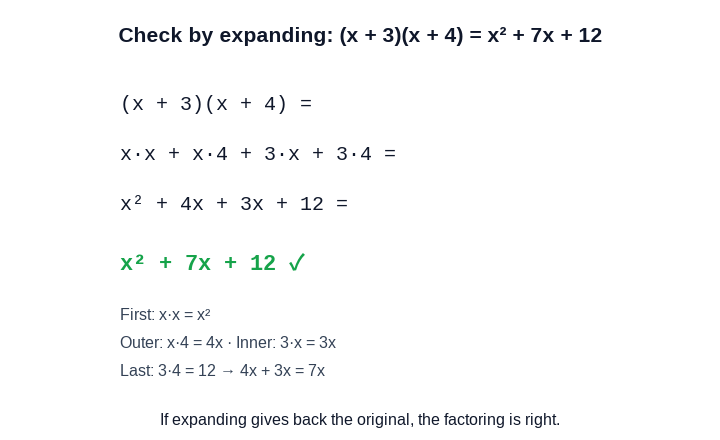
Multiply the factors back out — expanding (x + 3)(x + 4) must give back x² + 7x + 12. Then substitute each solution in to confirm it works.
Conclusion: factoring quadratic equations is a five-step habit
Once you can factor quadratic equations fluently, a whole family of problems becomes routine. Work the practice problems above until the decision table feels automatic.